


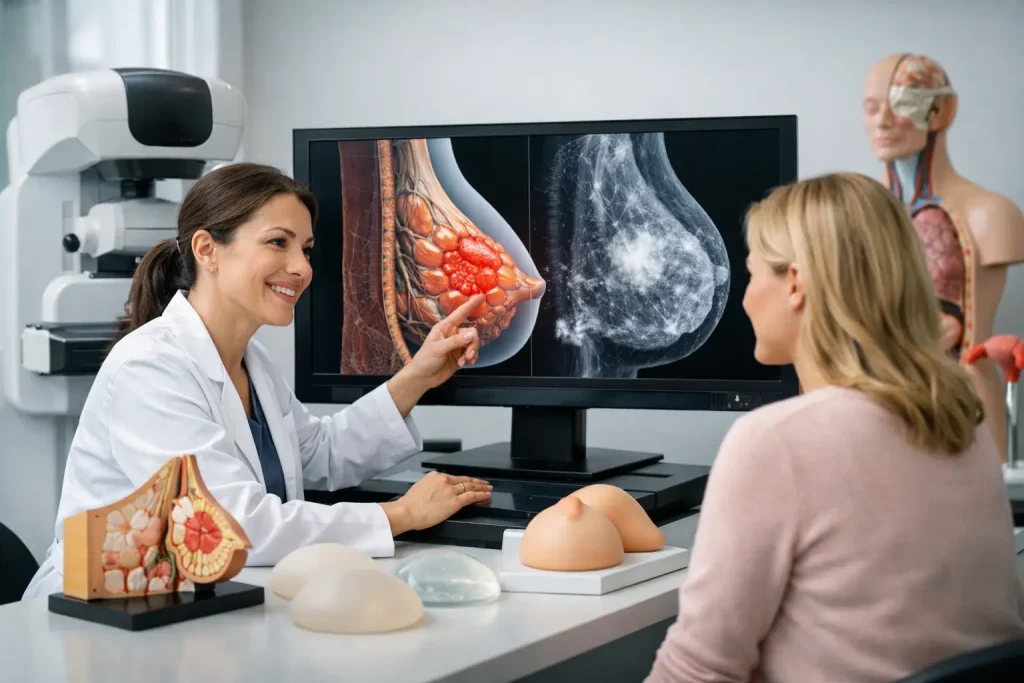
Choosing an implant size from a chart or trying on sizers in a bra can feel strangely outdated when the decision is this personal. Most patients do not want a bigger-or-smaller answer. They want to see proportion, upper-pole fullness, cleavage, side profile, and how the result might sit on their own frame. That is where 3d breast augmentation simulation becomes genuinely useful.
For a patient considering breast surgery at a high level, simulation is not a novelty. It is a planning instrument. Used well, it helps translate aesthetic goals into a more informed surgical design. Used poorly, it can create a false sense of certainty. The difference lies in how the technology is interpreted and who is guiding that interpretation.
What is 3d breast augmentation simulation?
A 3d breast augmentation simulation uses specialized imaging to create a digital model of your torso and project possible post-operative breast contours based on selected implant variables. Instead of imagining volume in abstract terms, you see a visual approximation built from your anatomy.
That matters because breast augmentation is never just about implant size. A 300 cc implant can look very different on a petite patient with a narrow chest than it does on someone with broader dimensions, more existing breast tissue, or a different skin envelope. The same implant can read elegant on one body and excessive on another. Simulation brings that reality into focus.
In premium aesthetic practice, this technology is most valuable when it is integrated into a surgeon’s design process rather than presented as a sales tool. The image on the screen should begin a conversation about proportion, not end it.
Why patients ask for 3d breast augmentation simulation
Most patients are not asking for technology for its own sake. They are asking for clarity.
They want to know whether moderate fullness or a more pronounced upper contour suits their frame. They want to compare profiles, visualize how implant width relates to the chest, and avoid the common fear of waking up either too small or unmistakably overdone. For international patients in particular, who may be planning surgery from abroad and making decisions before arriving in Istanbul, visual planning can make consultations far more concrete.
There is also an emotional dimension. Breast surgery is visible, identity-linked, and highly personal. Patients often come in with references, screenshots, and a general idea of what they admire, but those references rarely share their anatomy. A 3D simulation helps shift the discussion from someone else’s result to your own architectural possibilities.
What the simulation can show well
At its best, 3d breast augmentation simulation gives a strong sense of relative change. It can show how more or less projection affects the front and side view. It can illustrate whether a chosen implant starts to dominate the ribcage, whether the cleavage appears balanced, and whether the result aligns with a natural or more augmented aesthetic.
It is especially helpful for comparing options side by side. Many patients are deciding between two sizes that sound close numerically but look quite different in practice. A digital model can reveal that difference quickly.
It can also improve communication between patient and surgeon. Terms like natural, full, soft, athletic, or dramatic mean different things to different people. Visual planning reduces that ambiguity. Once a patient reacts to a simulated shape, the consultation becomes more precise. The surgeon can then explain what is surgically realistic, what may need adjustment, and where anatomy sets limits.
What the simulation cannot promise
This is the part sophisticated patients should pay close attention to. A simulation is not a guarantee, and no ethical surgeon should present it as one.
The software cannot perfectly predict how your skin will stretch, how your tissues will respond over time, how an implant will settle, or how healing will influence the final position. It does not fully account for scar maturation, subtle asymmetries that become more or less visible after surgery, or the dynamic way breasts move in real life.
It also cannot replace surgical judgment. Two patients may prefer the same simulated look, but one may be a good candidate for it and the other may not. Factors such as tissue thickness, breast base width, nipple position, chest wall shape, skin elasticity, and implant placement all affect what is achievable.
This is why simulation should be treated as a high-value preview, not a contractual image of the outcome.
The anatomy behind the image
A refined breast augmentation plan is built on measurements and artistic proportion. Implant volume is only one variable. Width, projection, implant type, tissue characteristics, and the position of the inframammary fold all matter.
For example, a patient with a narrow breast base cannot simply choose a very wide implant because she likes the fullness on a simulation. The implant must fit the anatomy. Likewise, a patient with thin tissue may need a different strategy from someone with more natural breast volume if the goal is a soft, discreet result.
This is where surgeon expertise becomes visible. The strongest consultations move fluidly between digital imaging and physical assessment. The simulation provides the visual language, while the examination provides the surgical truth.
How a specialist uses simulation during consultation
In a sophisticated consultation, simulation is part of a larger design discussion. The surgeon evaluates your proportions, listens to how you want to look in clothing and without it, reviews your tolerance for visible fullness, and considers whether your taste leans classic, athletic, sensual, or overtly augmented.
Then the simulation becomes a calibration tool. You may begin with one assumption and discover that a slightly different projection creates a more elegant balance. Or you may realize that what looked subtle in your head reads more dramatic on your frame than expected.
This process often narrows the gap between desire and reality in a productive way. Patients feel more informed, and the surgeon gains a clearer understanding of aesthetic priorities. In highly personalized breast design, that exchange is central.
Is 3d breast augmentation simulation accurate enough to trust?
Yes, with the right expectations.
It is accurate enough to be clinically helpful and strategically valuable. It is not accurate enough to be interpreted literally down to the millimeter. The most satisfied patients usually treat it as a directional model. They use it to choose a range, a shape philosophy, and a visual intention rather than one fixed promise.
That mindset tends to produce better decision-making. It leaves room for the surgeon to adapt intraoperatively when anatomy requires nuance, while still honoring the agreed aesthetic direction.
Patients who demand exact replication of the simulation are often misunderstanding what breast surgery involves. The body is not a static rendering. It heals, settles, and responds.
Who benefits most from this technology?
First-time breast augmentation patients often benefit the most because they have no prior surgical reference point. They may know what they do not want, but not yet understand how implant dimensions translate visually. Simulation shortens that learning curve.
Revision patients can also benefit, particularly when the goal is to correct imbalance, adjust size, or move from an obviously augmented look to something more refined. In those cases, visual modeling can help clarify what is feasible after previous surgery, though revisions are usually less predictable than primary cases.
Patients traveling for surgery also tend to value this technology. A consultation supported by 3D planning creates a more advanced and reassuring framework, especially when decisions need to be made efficiently without compromising sophistication.
Choosing a clinic is still more important than choosing software
Advanced imaging can elevate the planning experience, but it does not replace taste, judgment, or technical command. A beautifully rendered simulation means little if the surgeon lacks restraint, proportion awareness, or deep experience in breast aesthetics.
The right question is not simply, Do they offer 3D simulation? The better question is, How do they use it within their aesthetic philosophy and surgical method?
In a specialist setting such as DRGO Clinic, the value of simulation lies in its integration with high-level surgical expertise and a design-led approach to beauty. Technology alone does not create a refined result. Technology in the hands of a surgeon who understands both anatomy and form can.
If you are considering breast augmentation, 3d breast augmentation simulation is worth seeking out not because it replaces imagination, but because it sharpens it. The screen should help you ask better questions, see your proportions more honestly, and make a decision that feels informed before it feels exciting. That is usually where the best aesthetic outcomes begin.