

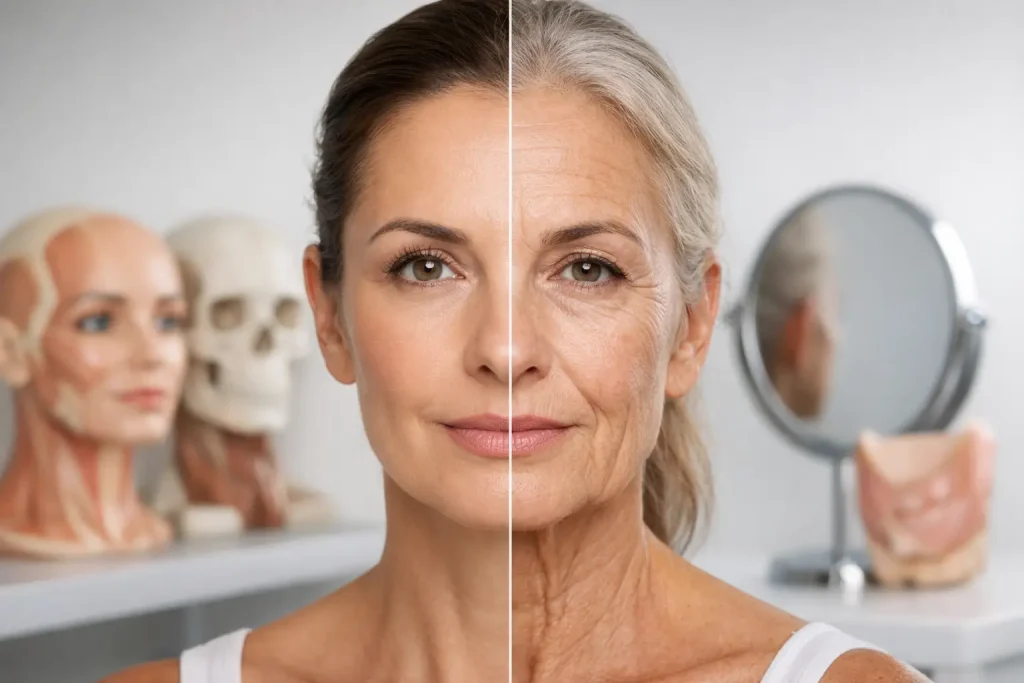
A face can look tired or older long before fine lines become the main concern. The concept behind 7 Anatomical Changes That Age Your Face is not simply about wrinkles. Facial aging is a layered structural process involving bone, fat compartments, ligaments, muscles, and skin. When these elements change at different rates, the face may lose the balanced proportions that once created a rested, youthful expression.
This is why refined facial rejuvenation should never be approached as a single-treatment concern. A fuller cheek does not always require filler, a jawline does not always require tightening, and a tired eye area is not always caused by excess skin. The most natural-looking outcomes begin with understanding which anatomical layer is responsible for the visible change.
Why Facial Aging Is a Structural Process
Youthful facial beauty is closely tied to smooth transitions: from lower eyelid to cheek, cheek to mouth, and jawline to neck. Over time, facial support changes. Volume may decrease in one region while shifting downward in another; skin may become thinner while the underlying framework gradually remodels.
Genetics, sun exposure, smoking, weight fluctuations, hormonal changes, sleep quality, and stress can all influence how quickly these changes become visible. Yet the pattern is highly individual. Two people of the same age can show entirely different signs of facial aging because their bone structure, fat distribution, skin quality, and tissue elasticity are not the same.
The 7 Anatomical Changes That Can Age the Face
1. Gradual Changes in Facial Bone Support
The facial skeleton is the architectural foundation of the face. With age, subtle remodeling can occur around the eye sockets, midface, jawline, and chin. These changes may reduce the support once provided to the soft tissues above them.
The result can be a less projected cheek, a more hollow appearance around the eyes, or a softer lower facial contour. This is one reason why surface-level treatments alone may not always deliver a balanced result. In selected patients, restoring proportion through carefully planned structural support can be more appropriate than adding volume indiscriminately.
2. Loss of Deep Midface Volume
The cheeks are not one uniform area of fat. They contain distinct fat compartments positioned at different depths. Deep midface volume contributes to the gentle convexity associated with a youthful face and supports the transition between the lower eyelid and cheek.
As this deep volume diminishes, the face can appear flatter, the under-eye area may look more hollow, and nasolabial folds can become more noticeable. This often creates an impression of fatigue rather than simply age. Strategic restoration of midface support may soften these transitions, but the goal should be refinement, not an overfilled appearance.
3. Descent and Redistribution of Superficial Fat
Facial aging is not only volume loss. Some fat compartments become more prominent or descend due to changing ligament support and tissue laxity. This is frequently visible in the lower face, where heaviness around the mouth, jowling, or a less defined jawline may develop.
Adding volume to a face with lower-face descent can sometimes make it look heavier. Depending on the anatomy, the more elegant solution may involve lifting, repositioning, or contour-focused treatment rather than additional filler. This distinction is central to advanced facial assessment.
4. Weakening of Facial Retaining Ligaments
Retaining ligaments function like internal support points, helping anchor facial soft tissues to deeper structures. As their tension and surrounding tissue quality change, the face may lose its crisp contours. The cheek can appear to descend, shadows around the mouth may deepen, and the jawline may become less distinct.
A facelift or deep-plane facial rejuvenation procedure may be considered when ligament-related descent is substantial. Non-surgical treatments can improve selected early changes, but they cannot reproduce the tissue repositioning achieved by surgery. The right choice depends on the degree of laxity, skin quality, facial volume, and the patient’s desired longevity.
5. Changes Around the Eyes and Orbital Hollowing
The eye area is often the first place where a person feels they look tired. With aging, the bony orbit can widen subtly, the brow may descend, upper eyelid skin can become more lax, and the lower eyelid-cheek junction may become more pronounced.
Under-eye hollows, puffiness, fine creasing, or a heavier upper lid may coexist, which is why this area requires particular precision. Treating a hollow lower eyelid with filler can be appropriate for some patients, but not for everyone. When skin laxity, fat prolapse, or significant tear-trough changes are present, eyelid surgery or a combined surgical approach may offer a more polished and enduring result.
6. Skin Thinning and Loss of Dermal Quality
Skin is the visible envelope of the face, but it does not age in isolation. Collagen, elastin, hydration, and cellular turnover gradually decline, while ultraviolet exposure can accelerate pigment irregularity, enlarged pores, rough texture, and fine lines.
Excellent skin quality enhances every other facial feature. However, skin treatments alone cannot lift descended tissue or rebuild lost structural support. Energy-based technologies, regenerative approaches, medical-grade skincare, and selected injectables may improve texture and luminosity, while surgical planning addresses deeper anatomical concerns when necessary. A sophisticated plan often combines both levels of care.
7. Lower-Face and Neck Contour Changes
A defined jawline is shaped by bone, fat, skin, muscle activity, and the neck’s deeper structures. With time, reduced skin elasticity, submental fat, platysma banding, jowl formation, and loss of chin support can alter the profile and make the face appear heavier.
This region benefits from diagnosis rather than a standard recipe. Neuromodulators may refine an overly active masseter or platysma in appropriate cases. Injectable contouring may help restore chin projection. For more advanced laxity, neck lift or facelift techniques can create a more meaningful restoration of definition. The aim is not to create an artificial sharpness, but to reestablish a contour that belongs naturally to the individual face.
Reading the Face as a Whole
The seven anatomical changes that age the face rarely appear separately. A patient may have deep midface volume loss, mild lower-face descent, and poor skin quality at the same time. Treating only one element may leave the overall facial expression unchanged or create imbalance.
For this reason, facial rejuvenation planning should consider the face in thirds, profile and frontal views, skin behavior, symmetry, and the dynamic movement of expression. A refined result preserves identity. It should allow a person to look refreshed, well-rested, and harmonious rather than visibly altered.
At Dr. Güncel Öztürk’s practice, the approach to facial aesthetics is shaped by this balance of anatomical precision and artistic judgment. Advanced imaging and individualized design can support the consultation process, helping clarify which changes are structural, which are surface-related, and which treatment pathway best suits the patient’s anatomy.
Choosing Between Non-Surgical and Surgical Options
Non-surgical treatments can be highly effective for early volume changes, dynamic lines, skin quality concerns, and subtle contour refinement. They usually involve less downtime and can be adjusted over time. Their limitations should also be understood: injectables cannot remove excess skin, reposition deeply descended tissue, or create the long-term structural correction of a well-planned surgical procedure.
Surgical facial rejuvenation may be appropriate when laxity, jowls, neck changes, eyelid concerns, or midface descent have become more established. Surgery requires recovery and thoughtful patient selection, but it can address the deeper anatomy responsible for visible aging. In many cases, the most natural strategy is neither exclusively surgical nor exclusively non-surgical, but a carefully sequenced combination.
A beautiful rejuvenation plan does not chase every line or erase every sign of time. It identifies the anatomical changes that most affect expression, then restores proportion with restraint, precision, and respect for the face that makes you recognizable.