


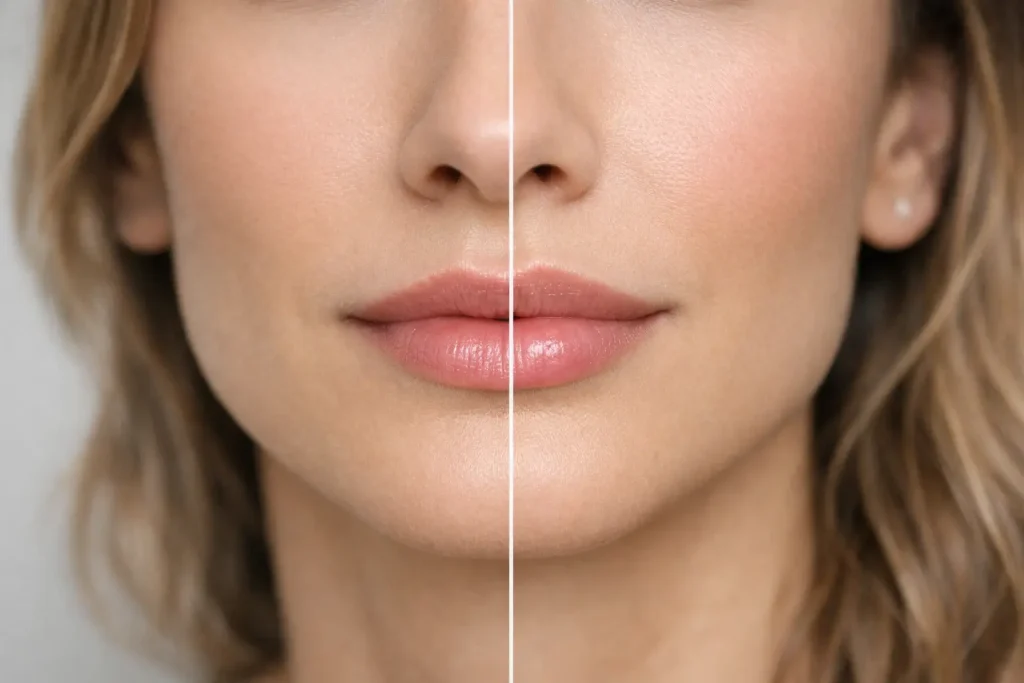
The most revealing part of a lip lift before and after comparison is rarely just the lip itself. It is the way the entire lower face changes once the upper lip is shortened with precision. The mouth can appear more defined, the smile more expressive, and the balance between nose, lips, and teeth more elegant. When the procedure is performed well, people often notice harmony before they notice surgery.
This is why lip lift surgery attracts patients who are not necessarily looking for bigger lips in the usual sense. Many have already tried filler, or realized that volume alone does not correct a long philtrum, limited tooth show, or an upper lip that rolls inward when they smile. A lip lift addresses structure rather than simply adding fullness, which is exactly why before-and-after results can look so distinctive.
What a lip lift before and after result should show
A refined result is not about creating a dramatic or exaggerated upper lip. It is about changing proportion. In a successful lip lift before and after set, the upper lip usually looks shorter, the cupid’s bow more visible, and the pink portion of the lip more exposed. There may also be more upper tooth show at rest or while smiling, which tends to create a more youthful and animated appearance.
This matters because aging affects more than skin quality. Over time, the distance between the base of the nose and the upper lip often lengthens, and the upper lip can flatten or droop. In photographs, the mouth may appear less defined even when the patient still has decent natural lip volume. A lip lift can restore architecture that filler alone cannot reliably recreate.
At the same time, not every improvement should be judged by the same standard. One patient may want a softer, more feminine contour. Another may want clearer dental show without looking overcorrected. For some, the goal is rejuvenation. For others, it is facial refinement that aligns the lips more beautifully with rhinoplasty, chin shaping, or other facial procedures.
Why photos can be misleading
Before-and-after imagery is valuable, but it needs to be interpreted with a trained eye. Lighting, lip posture, makeup, swelling stage, and even camera angle can distort the impression of results. An upper lip photographed with a slight smile will always look different from one photographed fully relaxed. The best comparisons are consistent in angle, expression, and timing.
Another issue is that early after photos are often not the final result. A lip lift can look tighter, fuller, or slightly uneven in the first weeks because tissues are still settling. Patients who judge the outcome too early sometimes mistake normal healing for a permanent issue. The more sophisticated question is not whether the lip looks different at two weeks, but whether it is healing into natural proportion at two to three months and beyond.
The main changes patients notice after surgery
The most appreciated improvement is usually shape, not size. After healing, the upper lip often looks more present without appearing artificially filled. The philtrum is shorter. The vermilion, which is the visible pink lip, has better show. The cupid’s bow can become more sculpted, and the central lip may appear gently everted rather than tucked inward.
Many patients also notice that lipstick sits differently and photographs more beautifully. Facial expression may look more open, especially in profile and three-quarter view. This is one reason the procedure appeals to image-conscious patients who are sensitive to subtle imbalance.
There are trade-offs, of course. A lip lift is surgery, not a lunchtime treatment. It creates a permanent structural change and usually involves a scar hidden at the base of the nose. When executed with finesse, that scar tends to become discreet. But discreet is not the same as nonexistent, and mature decision-making starts with that distinction.
Who tends to get the best lip lift before and after outcome
The strongest candidates are usually patients with a long upper lip, limited tooth show, upper lip descent related to aging, or lips that have not responded well to filler-based correction. Some younger patients also benefit when anatomy, rather than age, is the issue.
A patient with a naturally short upper lip, very prominent gums, or unrealistic expectations may not be an ideal surgical candidate. Similarly, someone who mainly wants bigger lips rather than a more elegant lip position may be better served by another approach. The best outcomes come from matching the procedure to the actual anatomical problem.
This is where specialist judgment matters. A lip lift is a small operation, but it is not a minor aesthetic decision. Millimeters matter. Over-resection can look strained or overly exposed. Under-correction may leave the patient wondering why they had surgery at all. The artistry lies in creating a lip that looks naturally suited to the face rather than visibly altered.
Recovery: what before and after does not always reveal
Most before-and-after galleries emphasize the endpoint, not the healing journey. In reality, patients should expect swelling, temporary tightness, and a healing scar that evolves over time. The first week is often the most socially noticeable. Sutures may be present, expression can feel restricted, and the lip may look more elevated than intended.
By the second or third week, many patients begin to look more presentable, but subtle swelling often persists longer than expected. The scar can remain pink for a period before fading. Final refinement is gradual. This is why lip lift recovery rewards patience.
There is also an emotional aspect to recovery. Because the lips are central to speech, expression, and identity, even small temporary changes can feel significant. Patients who do best are usually those who understand the timeline and choose surgery at a moment when they can allow healing to unfold without panic.
Scar quality is part of the result
A beautiful lip lift before and after result depends as much on scar design as on lip design. The incision is commonly placed beneath the nose in a way that follows natural contours, often called a bullhorn pattern. Good scar placement aims to conceal the incision within the shadows and curves of the nasal base.
Scar visibility depends on several variables: surgical technique, tissue handling, individual skin quality, post-operative care, and healing biology. Some patients heal exceptionally well. Others may have redness or textural irregularity that takes longer to settle. This does not necessarily mean the surgery was poorly done, but it does mean the scar deserves serious discussion before any procedure is booked.
In premium aesthetic practice, the philosophy should never be simply to lift the lip. It should be to elevate the mouth while protecting facial elegance from every angle, including conversational distance and close photography.
Lip lift vs filler in before and after comparisons
This is where many patients gain clarity. Filler can add volume, improve hydration, and create contour. What it cannot reliably do is shorten the white upper lip or consistently increase tooth show in a natural, lasting way. In some faces, repeated filler can even make the lip look heavier rather than more refined.
A lip lift changes position. Filler changes volume. Some patients need one, some the other, and some benefit from a carefully sequenced combination. The mistake is assuming they are interchangeable. They are not.
For patients researching surgical refinement at a high level, the most sophisticated consultation is one that explains not only what can be done, but what should be left alone. Sometimes restraint is the mark of expertise.
Choosing a surgeon for lip lift surgery
Because a lip lift affects central facial balance, surgeon selection should be exacting. Look beyond basic credentials and focus on aesthetic consistency, scar quality, and whether the surgeon’s results preserve individuality. The right surgeon understands lips not as isolated features, but as part of a wider facial composition.
This is especially relevant in specialist practices where facial surgery is approached with both technical rigor and artistic judgment. At the premium end of aesthetic medicine, design matters as much as execution. Patients considering care through an expert-led clinic such as DRGO Clinic often respond to this blend of anatomical precision and aesthetic authorship, particularly when they want a result that reads as polished rather than operated on.
The most realistic way to judge your future result
A good lip lift before and after gallery can educate, but it cannot predict your exact outcome. Your anatomy, skin quality, scar behavior, smile dynamics, and aesthetic goals will shape the result. That is why the consultation matters more than the photo carousel.
The most useful question is not, “Can I have this person’s lips?” It is, “What version of balance is possible for my face?” When that question is answered honestly, the best before-and-after results stop looking like transformations for their own sake. They begin to look like refinement with intention.
The right lip lift should not make you look like someone new. It should make your features appear as though they were always meant to sit this way.