

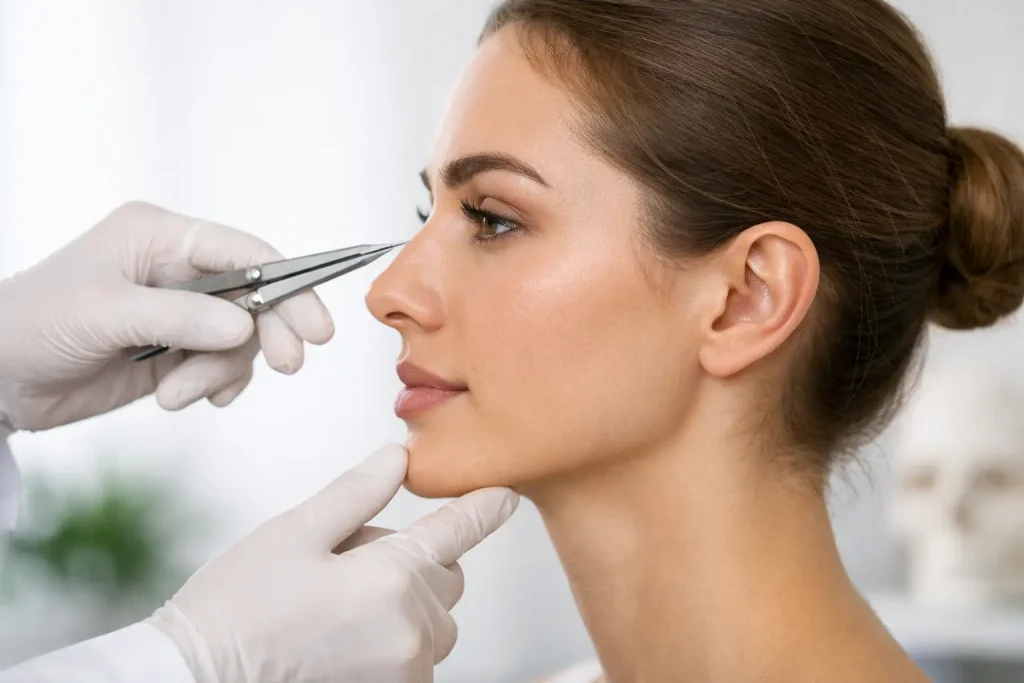
A technically perfect nose can still look wrong on the face around it. That is the central reason patients researching how facial proportions influence rhinoplasty outcomes are often surprised by what matters most in consultation: not just the nose itself, but the relationship between the nose, chin, forehead, lips, cheek volume, and overall facial geometry.
Rhinoplasty is not simply a reduction procedure or a shape-correction procedure. At a high level, it is a proportional design surgery. The most refined outcomes come from understanding the nose as one element within a larger composition. A nose that appears elegant in isolation may feel too narrow for stronger cheekbones, too projected for a delicate chin, or too lifted for a longer upper lip. The goal is not to create a fashionable nose. The goal is to create facial harmony.
Why facial proportions matter more than nose size
Many patients arrive focused on one visible concern – a hump, a wide bridge, a drooping tip, asymmetry, or a nose that feels too large in photographs. These concerns are valid, but the eye rarely judges the nose alone. It reads balance.
A nose can seem large because the chin is under-projected. It can look heavy because the midface lacks structural support. It can appear over-rotated after surgery not because the tip is technically poor, but because the forehead angle, lip position, and jawline make the new shape feel disconnected from the rest of the face.
This is why high-level rhinoplasty planning begins with facial analysis rather than isolated nasal analysis. The surgeon studies proportions in frontal view, profile view, three-quarter view, and dynamic expression. A result that suits one face may look artificial on another, even when the same techniques are used.
How facial proportions influence rhinoplasty outcomes in profile
The side profile is often where balance becomes most obvious. Patients usually focus on the dorsal hump or tip projection, but the profile is a chain of relationships.
The forehead-to-nose transition affects whether the bridge looks harsh or soft. The nasal projection affects how prominent the nose appears relative to the lips and chin. The tip rotation influences whether the lower third of the face looks youthful, refined, severe, or overly operated.
Chin position is especially important. A weak chin can make the nose appear larger than it truly is. In those cases, an aggressive rhinoplasty may reduce the nose, yet still fail to create overall harmony. Sometimes the better aesthetic decision is a more conservative rhinoplasty combined with appreciation of the chin’s role in profile balance. This does not mean every patient needs an additional procedure. It means the nose should be designed in context, not in isolation.
Lip position also matters. If the upper lip is long or retrusive, excessive tip rotation can create visual tension. If the lips are more projected, a certain nasal projection may feel proportionate and elegant. The best profile results often come from restraint – enough change to refine, but not so much that the nose no longer belongs to the face.
Frontal balance is just as important
Patients often underestimate the frontal view because profile images dominate rhinoplasty discussions. In reality, frontal harmony is where naturalness is tested.
Bridge width must suit the distance between the eyes and the width of the midface. A bridge that is narrowed too aggressively can look pinched, particularly in faces with stronger bone structure or thicker skin. Tip definition must also match facial character. A delicate, highly sculpted tip may work beautifully on a fine-boned face, while the same tip design can look fragile or unnatural on a broader face.
Nasal length is another subtle factor. A shorter nose is not automatically more attractive. On some faces, shortening can disturb vertical proportions and make the lower face appear longer. On others, reducing length creates freshness and refinement. The decision depends on how the nose relates to the upper, middle, and lower thirds of the face.
Ethnicity, sex, skin quality, and facial identity
Facial proportions are not abstract measurements alone. They are shaped by identity.
A successful rhinoplasty respects ethnic anatomy, sex-specific characteristics, and the patient’s existing facial language. An elegant female rhinoplasty and a refined male rhinoplasty are not interchangeable design concepts. Excessive narrowing, over-rotation, or over-definition can erase character and create a generic result.
Skin thickness also changes what proportion will read as beautiful. Thick skin tends to soften contour definition, which means structural planning becomes critical. Thin skin reveals every irregularity, so precision matters at another level. The same intended shape can present very differently depending on tissue quality.
This is one reason sophisticated rhinoplasty cannot be planned from inspiration photos alone. A reference image may reflect a different skeletal base, different skin behavior, different facial width, and different proportional framework. What suits one patient may compromise another.
The role of 3D planning and artistic judgment
Modern rhinoplasty benefits from advanced imaging and simulation, but technology is only part of the equation. Measurement can guide planning, yet beautiful outcomes are not produced by numbers alone.
Facial analysis includes angles, lengths, widths, and ratios, but aesthetic judgment determines how those measurements should be interpreted. Not every mathematical proportion is attractive in every individual. Some faces benefit from stronger definition. Others need softness. Some can tolerate a dramatic profile change. Others look more expensive, more elegant, and more believable with subtle refinement.
This is where an art-driven surgical philosophy becomes valuable. In premium rhinoplasty practice, the surgeon is not only correcting anatomy. He is editing form. The decision to preserve a trace of dorsal height, maintain a little more tip strength, or avoid excessive narrowing may be what protects the patient from an overdone result. At this level, restraint is often a sign of expertise.
Assoc. Prof. Dr. Güncel Öztürk’s approach is known for combining surgical precision with an artistic perspective, which is particularly relevant in rhinoplasty because the operation sits at the intersection of structure, function, and visual proportion.
Why proportional analysis prevents common disappointments
Many disappointing rhinoplasty outcomes are not obvious surgical failures. They are proportional failures.
The nose may be smaller, yet the face looks less balanced. The bridge may be straight, yet the result feels too hard for the patient’s features. The tip may be lifted, yet the expression changes in a way the patient did not expect. These outcomes often happen when the procedure is planned around a single complaint rather than the whole face.
Over-reduction is a classic example. Patients sometimes request a smaller nose, assuming smaller means better. But if the new nose is too small for the facial framework, it can flatten identity and make other features appear disproportionate. The result may photograph well from one angle while looking unnatural in conversation or motion.
Another issue is chasing symmetry too aggressively. Perfect symmetry is rarely realistic in a living face, and subtle asymmetry can be part of what makes a result look natural. Rhinoplasty should improve balance, not create stiffness.
What patients should expect during consultation
A high-quality rhinoplasty consultation should feel more like design analysis than product selection. The discussion should go beyond what the patient dislikes and move toward what the face needs.
That means evaluating the nasal bones, septum, tip cartilages, skin envelope, and breathing function, while also studying chin support, facial thirds, projection, and overall contour. Patients should expect an honest conversation about trade-offs. A very small tip may not be stable. A very narrow bridge may not suit the eyes or skin thickness. A dramatic change may not age as well as a balanced one.
The strongest consultations also clarify aesthetic language. When a patient says “natural,” that can mean many different things. For one person it means subtle profile change. For another it means a refined tip with preserved ethnic identity. For another it means looking better without looking surgically altered. The surgeon’s role is to translate that request into proportions that work on the individual face.
How to think about the best rhinoplasty result
The best rhinoplasty is rarely the nose that gets the most attention. It is the nose that makes the entire face look more coherent, more polished, and more naturally attractive.
When facial proportions are respected, people often notice that the patient looks better rested, more elegant, or more balanced without immediately identifying why. That is a sophisticated result. It reflects not just technical control, but judgment.
If you are considering rhinoplasty, it is worth asking a better question than how small or straight the nose can become. Ask how your facial proportions influence rhinoplasty outcomes, and whether the surgical plan is designed to serve your face as a whole. That is where refined results begin – and where they continue to look right long after trends have changed.