

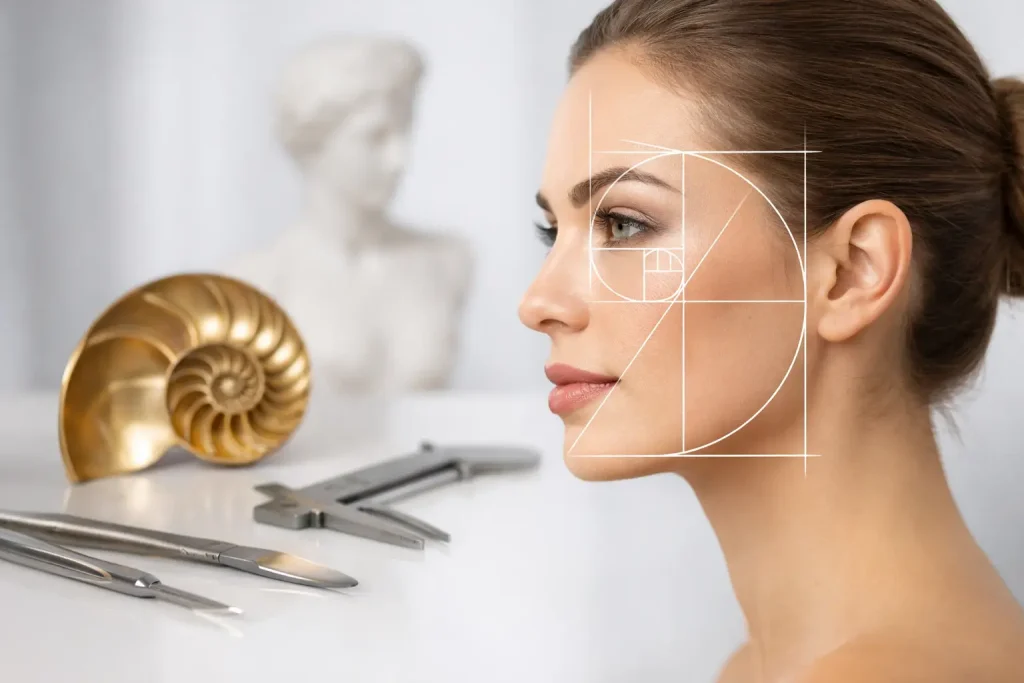
A beautifully balanced face is rarely about one feature in isolation. It is about proportion, rhythm, and how each structure relates to the next. That is exactly why patients often ask, How the Golden Ratio Shapes Aesthetic Surgery? The short answer is yes, but not as a rigid formula. In refined aesthetic surgery, the golden ratio can serve as a reference point, yet the final design must still respect anatomy, ethnicity, facial character, tissue quality, and the patient’s own aesthetic goals.
What is the golden ratio?
The golden ratio is a mathematical proportion, approximately 1.618, that has long been associated with visual harmony in art, architecture, and nature. You may see it described in classical sculpture, Renaissance painting, and even in patterns found in leaves, shells, and the human body.
In aesthetics, this concept attracts attention because the human eye tends to perceive certain proportional relationships as balanced. That does not mean beauty can be reduced to a single number. It means some recurring ratios appear pleasing more often than others.
For that reason, the golden ratio is better understood as a design reference than a beauty rule. In plastic surgery, especially facial procedures, it can help guide analysis. It should never override clinical judgment or individuality.
How the Golden Ratio Shapes Aesthetic Surgery?
Yes, it is used, but selectively and intelligently. In contemporary aesthetic surgery, proportion matters far more than chasing a textbook ideal. Surgeons may evaluate distances, angles, projection, and symmetry using principles that overlap with the golden ratio. This is particularly relevant in rhinoplasty, facial rejuvenation, lip design, chin contouring, and some aspects of breast aesthetics.
Still, the most sophisticated surgeons do not treat the face like a geometry problem. A mathematically balanced result can still look artificial if it ignores expression, skin thickness, structural support, or the patient’s ethnic identity. True aesthetic judgment lives in the space between measurement and artistry.
That distinction matters. Patients seeking premium outcomes are not asking to look generic. They want refinement, not replacement. They want features to appear elegant, natural, and coherent from every angle – not simply closer to a number.
Where the golden ratio is most relevant in facial aesthetics
The face is where proportional analysis becomes most useful. Surgeons often examine the relationship between forehead, nose, lips, chin, cheek volume, jawline definition, and the distances between key landmarks. The goal is not to make every patient identical. The goal is to create visual harmony.
Nose and facial balance
Rhinoplasty is one of the clearest examples. A nose is never judged on its own. Its width, length, projection, tip definition, and dorsal line all interact with the forehead, upper lip, chin, and cheeks. A smaller nose is not automatically a better nose. In some faces, making the nose too small actually disrupts balance and weakens character.
This is why advanced rhinoplasty planning often includes profile analysis, front-view proportions, and digital simulation. The surgeon studies how the nose fits the whole face. Golden ratio thinking can inform that process, but the best result comes from a tailored composition, not from forcing a universal nose shape.
Lips, chin, and profile design
Lip aesthetics are another area where proportion matters deeply. The relationship between upper and lower lip volume, lip projection, philtrum length, and chin position affects how youthful, elegant, or overfilled the face appears.
A patient may believe the lips are the issue when the real imbalance comes from a retrusive chin or weak lower-face support. In that setting, adding volume alone can produce a heavy or unnatural result. A proportion-based analysis helps identify what truly needs adjustment.
Eyes, brows, and facial thirds
Facial rejuvenation also relies on proportion. The face is often evaluated in horizontal thirds and vertical fifths, with attention to brow position, eyelid show, cheek fullness, and jawline transition. These frameworks are not identical to the golden ratio, but they reflect the same principle: beauty often depends on relationships, not single features.
A skilled surgeon uses these measurements to understand aging patterns and structural imbalance. Then comes the more refined part – deciding how much correction is enough.
Does the golden ratio apply to breast and body aesthetics?
It can, but more loosely. In breast aesthetics, surgeons evaluate breast width, nipple position, upper-pole fullness, inframammary fold location, and the relationship between the breast and the chest wall. There is no single perfect breast ratio for every body type. Height, shoulder width, ribcage shape, tissue thickness, and lifestyle all influence what looks natural.
The same is true in body contouring. Waist-to-hip ratio is often discussed because it strongly affects the perception of femininity and silhouette. Yet even here, aesthetic success depends on proportion within the patient’s own frame. Aggressive sculpting may create dramatic numbers while sacrificing softness, movement, or long-term elegance.
In premium aesthetic surgery, beauty is not built through standardization. It is built through customization.
The limits of the golden ratio in surgery
This is where patients benefit from nuance. The golden ratio has cultural appeal because it sounds objective. People like the idea that beauty can be measured. But surgery is performed on living tissue, not on static drawings.
Faces are dynamic. They smile, age, swell, heal, and express emotion. Skin quality varies. Cartilage strength varies. Bone structure varies. Even two patients with similar proportions may need completely different surgical strategies.
There is also the issue of cultural and ethnic aesthetics. A proportion considered ideal in one population may not translate elegantly to another. Respecting identity is essential. A successful result should look elevated, not ethnically erased or stylistically imported.
For that reason, overreliance on mathematical ideals can flatten individuality. The most beautiful outcomes often preserve a patient’s recognizable essence while refining imbalance.
What sophisticated aesthetic planning looks like
In modern practice, proportion analysis is only one layer of planning. High-level surgical design combines measurements with clinical examination, photography, dynamic facial assessment, and increasingly, 3D imaging or simulation.
This matters because patients are not only choosing a procedure. They are choosing a point of view. A surgeon with artistic discipline will look beyond isolated corrections and ask a more elevated question: what change will make the entire face or body read as more harmonious?
That philosophy is especially relevant in rhinoplasty and facial aesthetics, where a few millimeters can shift the entire visual identity of the patient. An elegant result often depends less on how much is changed and more on what is left untouched.
At this level, surgery becomes design-led medicine. The mathematics support the eye, but they do not replace it.
How patients should think about how the golden ratio shapes aesthetic surgery?
If you are researching surgery, the most useful way to approach this question is not, “Will my surgeon make me fit the golden ratio?” A better question is, “Does my surgeon understand proportion deeply enough to create a result that suits me?”
That difference is substantial. A surgeon may reference ideal ratios, but what you want is judgment. You want someone who can see where balance is missing, explain why, and choose the least excessive path to improvement.
This is also why consultation quality matters so much. The best consultations do not sell a prepackaged look. They analyze structure, discuss trade-offs, and clarify what is achievable based on your anatomy. In a premium setting, aesthetic medicine should feel both highly technical and highly personal.
For patients considering facial refinement, this often means accepting that the right plan may be subtler than expected. Sometimes the elegant answer is not more projection, more volume, or more reduction. Sometimes it is restraint.
A refined surgeon may use the golden ratio as one of many intellectual tools, much like an architect uses classical proportion while still designing for the site, the light, and the person who will live inside the space. That is the level at which aesthetic surgery becomes more than correction. It becomes composition.
Assoc. Prof. Dr. Güncel Öztürk’s approach to aesthetic design reflects this balance between science and artistry, where advanced planning supports outcomes that feel individualized rather than formulaic.
If there is one idea worth keeping, it is this: beauty in surgery is rarely created by chasing perfection. It is created by understanding proportion well enough to know when to refine, when to preserve, and when to stop.