

A fuller breast shape is not a single aesthetic request. One patient may want a subtle restoration after pregnancy; another may seek clearer upper-pole definition, improved symmetry, or a more visible change in proportion. That is why the question of fat transfer vs breast implants deserves more than a simple answer. Both techniques can create elegant, confidence-enhancing results, but they create them through very different surgical strategies.
The right choice begins with anatomy, not trends. Breast tissue quality, chest width, skin elasticity, available donor fat, lifestyle, and the degree of desired volume all shape the surgical plan. The most refined result is not necessarily the largest one. It is the one that appears balanced, soft, and convincingly your own.
Fat Transfer vs Breast Implants: The Fundamental Difference
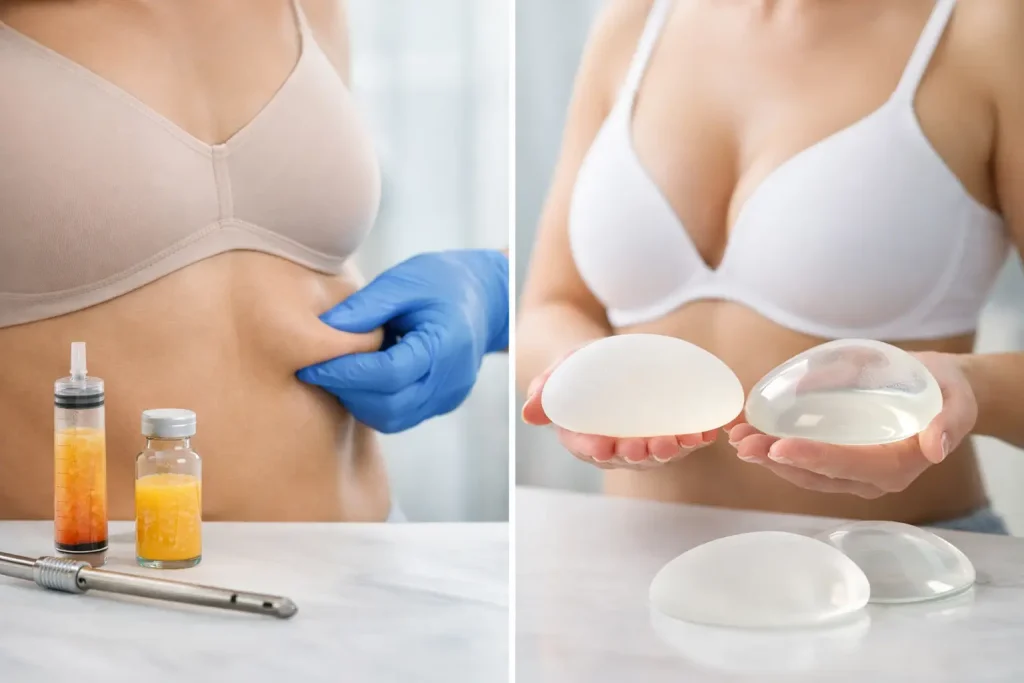
Breast augmentation with implants adds volume using a silicone or saline medical device placed beneath or above the chest muscle, depending on the patient’s anatomy and surgical plan. Modern silicone gel implants are the preferred choice for many patients because they can provide a soft, cohesive feel and a wide range of profiles, widths, and projection options.
Fat transfer breast augmentation uses the patient’s own tissue. Fat is gently harvested through liposuction from areas such as the abdomen, waist, thighs, or back. After purification, selected fat cells are carefully placed in multiple layers of the breast to improve volume, contour, and softness.
This distinction affects nearly every part of the experience. Implants offer more predictable volume and more substantial enlargement in one operation. Fat transfer offers a natural-tissue approach with the added contouring benefit of liposuction, but the amount of volume that can be achieved is limited by both donor fat availability and how much of the transferred fat survives.
When Fat Transfer Creates Its Best Results
Fat transfer is particularly compelling for patients who want refinement rather than dramatic enlargement. It can be an excellent choice for restoring modest volume after weight loss, pregnancy, or breastfeeding; softening visible implant edges; improving mild asymmetry; and enhancing cleavage or the upper breast with a subtle, natural contour.
Because the transferred tissue is your own, the breast often feels remarkably natural. There is no implant shell, no device-related maintenance, and no foreign material placed within the breast. Liposuction also allows the surgeon to refine donor areas, creating an appealing relationship between a more defined waist or torso and enhanced breast shape.
However, fat transfer is not simply liposuction plus injection. It is a meticulous grafting procedure. The surgeon must place small quantities of purified fat into well-vascularized tissue so the cells can establish a blood supply. Some of the transferred fat will naturally be reabsorbed during healing. While long-term retention can be very satisfying, the final volume is less predictable than an implant and may require a staged treatment for patients seeking a more noticeable increase.
A patient also needs adequate donor fat. Very lean individuals may not have enough harvestable tissue to produce a meaningful breast enhancement. In that situation, attempting to force a fat-transfer approach can compromise the design rather than serve it.
The aesthetic character of fat transfer
Fat transfer tends to create a soft, diffuse increase in fullness. It is especially effective when the goal is to preserve a naturally proportioned silhouette in fitted clothing and without clothing. It does not usually create the highly projected, rounded upper-pole look that some patients associate with traditional augmentation.
For women who prefer their breast enhancement to be difficult for others to identify, this can be a distinct advantage. For those seeking a significant cup-size increase or a very sculpted, implant-like profile, it may be too subtle on its own.
When Breast Implants Offer a Better Solution
Implants remain the most reliable choice when a patient wants a larger and more controllable increase in breast volume. They enable the surgeon to select dimensions that correspond to the chest wall, existing breast tissue, and desired projection. This allows for a high degree of precision in shaping the breast footprint, lower-pole fullness, and upper-pole contour.
They are also appropriate for patients with limited body fat, those who want a more substantial enlargement in one procedure, and patients whose breast shape requires structural support beyond what fat grafting alone can provide. The range of implant profiles makes it possible to pursue a quietly natural look, a fuller décolletage, or a more projected silhouette without treating every body with the same formula.
The trade-off is that implants are medical devices, not lifetime products. They do not need to be replaced on a fixed schedule if they are functioning well, but future monitoring and, in some cases, revision surgery should be part of the decision from the beginning. Changes in weight, pregnancy, aging, and skin quality can also alter the appearance of augmented breasts over time.
Potential implant-related concerns include capsular contracture, rupture, rippling, malposition, and the possibility of future revision. Patients should also discuss the rare association between certain textured implants and breast implant-associated anaplastic large cell lymphoma, as well as any concerns about systemic symptoms sometimes described as breast implant illness. A thoughtful consultation should address these subjects directly, without minimizing them or allowing them to eclipse the substantial body of experience with modern breast augmentation.
Recovery, Scars, and Long-Term Considerations
Recovery differs because the procedures involve different areas of the body. After implant surgery, patients commonly experience chest tightness, swelling, and temporary limitations in upper-body movement. Most return to light daily activity relatively quickly, while exercise and lifting restrictions continue for several weeks according to the surgeon’s protocol.
Fat transfer recovery includes the breast area and the liposuction donor sites. The breasts may feel swollen initially, while the abdomen, flanks, or thighs can have bruising, tenderness, and the need for compression garments. Patients are often advised to avoid significant pressure on the breasts during early healing, since protecting the grafted tissue supports fat survival.
Scars are typically discreet with both procedures. Implant augmentation usually requires a short incision, often positioned in the breast crease. Fat transfer uses very small liposuction entry points, though their placement and healing still deserve careful planning. Scar quality ultimately depends on surgical technique, skin characteristics, and adherence to aftercare.
Long term, retained fat behaves like living tissue. It can enlarge or reduce with significant weight changes, which makes weight stability valuable after surgery. Implants maintain their manufactured volume, but the surrounding breast tissue and skin continue to age naturally.
A Hybrid Approach Can Be the Most Artful Answer
The choice is not always either-or. A hybrid breast augmentation combines a modest implant with carefully placed fat transfer. The implant provides dependable volume and projection, while fat can soften transitions at the upper breast, improve cleavage lines, camouflage mild rippling, or correct asymmetries.
This approach can be particularly valuable for patients with thin soft-tissue coverage who want implant volume but still prioritize a natural-looking breast contour. It requires judgment rather than excess. The objective is not to add every available technique, but to use each one where it contributes meaningfully to the final composition.
How to Make the Decision With Confidence
Before choosing a procedure, define what “natural” means to you. For some patients, it means breast tissue that feels entirely their own. For others, it means a proportionate result with a stable, predictable silhouette. Bring reference images to a consultation, but use them as a starting point rather than a prescription. A result that flatters one frame may not harmonize with another.
A detailed assessment should include breast measurements, chest-wall shape, tissue thickness, asymmetry, skin laxity, nipple position, and donor-fat availability. Advanced planning and imaging can help translate aesthetic preferences into a surgical design, but they should support expert judgment, not replace it. At a design-led practice such as Assoc. Prof. Dr. Güncel Öztürk’s, breast surgery is approached as a balance of anatomy, proportion, and individual visual identity.
The most valuable decision is the one that still feels right after the swelling resolves and the novelty fades. Choose the technique that respects your body’s starting point, your tolerance for future procedures, and the version of yourself you want to see with quiet confidence.