

A face can be technically balanced and still not feel like the right face for its owner. That distinction sits at the center of the psychology behind facial harmony. Aesthetic perception is not simply a measurement of nose width, lip volume, jawline angle, or cheek projection. It is a rapid, deeply personal reading of proportion, expression, familiarity, identity, and emotional presence.
For patients considering rhinoplasty, facial rejuvenation, injectables, or a more comprehensive refinement, the most meaningful question is rarely, “What is the ideal feature?” It is, “What will allow me to look more like myself, with greater clarity and confidence?” The answer requires both scientific understanding and artistic judgment.
Facial Harmony Is About Relationships, Not Perfect Features
The human brain does not view the face as a collection of isolated parts. It processes the eyes, nose, lips, chin, forehead, skin quality, and facial contours as an integrated composition. This is why a beautifully shaped nose may appear out of place if it does not suit the chin, the midface, or the character of the eyes. It is also why a subtle adjustment to one feature can change the perceived balance of the entire face.
Harmony is often mistaken for symmetry. Symmetry can contribute to visual balance, but a perfectly mirrored face is neither common nor necessarily more attractive. Small asymmetries create individuality. They can make an expression warmer, more memorable, or more distinctly personal. The goal of refined aesthetic treatment is not to erase every difference. It is to understand which differences are part of a patient’s identity and which ones create unwanted distraction.
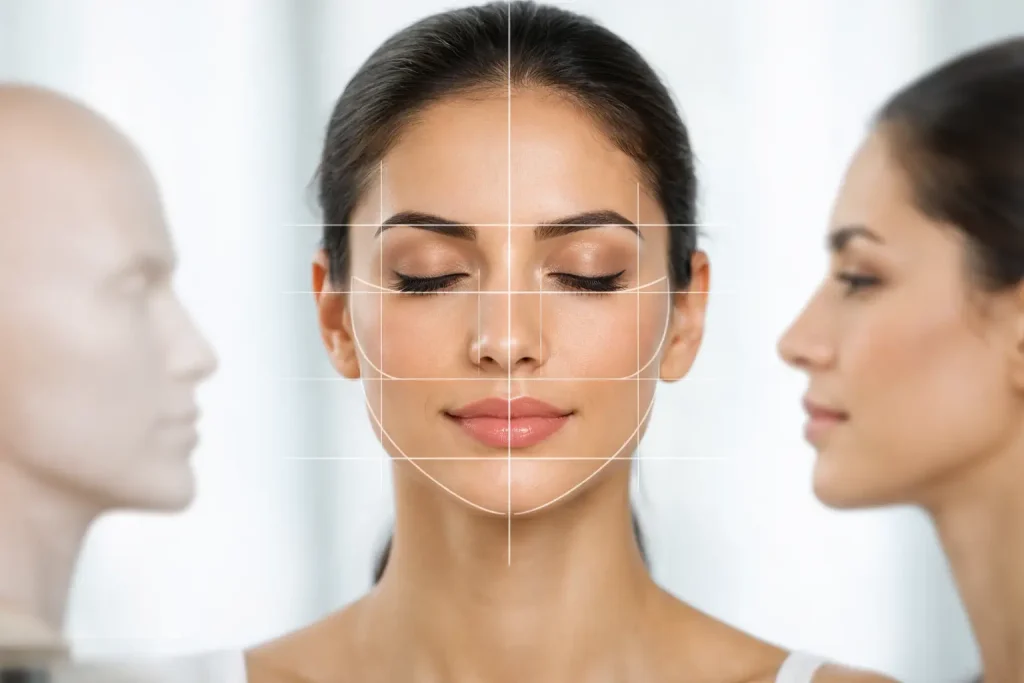
In clinical aesthetic planning, proportion is therefore a guide rather than a rigid formula. Facial thirds, profile angles, chin projection, nasal proportions, and lip-to-chin relationships offer useful reference points. Yet the most successful plans account for age, ethnicity, sex, bone structure, skin thickness, animation, and personal aesthetic preference. Numbers can inform the design. They cannot replace discernment.
Why the Brain Notices Facial Balance So Quickly
Humans are highly attuned to faces. We recognize expressions in fractions of a second and make unconscious judgments about vitality, approachability, health, and confidence long before we can explain why. This sensitivity has practical consequences in aesthetic medicine: even a minor change can feel significant because the face is central to social recognition.
The brain tends to favor visual coherence. When proportions appear to relate naturally to one another, the face is easier to process. That ease may be experienced as attractiveness, elegance, or a sense that someone looks well-rested and healthy. Conversely, a feature that dominates the composition can pull attention away from the eyes and expression, even when that feature is objectively attractive on its own.
This does not mean beauty is universal or fixed. Cultural ideals influence what people find attractive, and personal taste matters greatly. A patient who values a more sculpted profile may have a different vision from someone who prefers a softer, less altered appearance. The psychological principle is not that every face should follow one standard. It is that visual relationships shape how a face is perceived.
The Role of Familiarity and Identity
A person’s face is not merely an image. It is an identity anchor. It appears in mirrors, photographs, family memories, professional settings, and daily social interactions. That is why facial aesthetic decisions can carry more emotional weight than changes elsewhere on the body.
Many patients do not want to become unrecognizable. They want to reduce a feature that has drawn attention for years, restore volume lost over time, or bring a profile into better balance while preserving the qualities people associate with them. A natural-looking result is not simply a conservative result. It is a result that protects continuity of identity.
This is particularly relevant in rhinoplasty. The nose occupies the center of the face, affects frontal and profile views, and contributes to perceived facial character. A nose designed without respect for the patient’s overall facial architecture may look surgically altered, even if the technical work is precise. By contrast, an individually designed nose can allow the eyes, lips, and expression to take greater prominence while still looking inherently familiar.
The Emotional Difference Between Refinement and Transformation
Aesthetic surgery is often discussed in terms of transformation, but that word can be misleading. Dramatic change may be appropriate in selected reconstructive situations or for patients with substantial anatomical concerns. In elective facial aesthetics, however, the most psychologically satisfying outcome is often refinement.
Refinement reduces visual conflict. It may involve smoothing a nasal hump while retaining appropriate nasal strength, restoring cheek support without creating excessive fullness, or enhancing lip shape without overwhelming the lower face. These choices are subtle in isolation, but their cumulative effect can be powerful. The face appears more rested, proportionate, and aligned with how the patient wishes to be seen.
There is a trade-off. The more aggressively a feature is altered, the greater the possibility that the result may compete with the patient’s natural identity or age differently over time. Less intervention can preserve character but may not address a concern strongly enough. The appropriate balance depends on anatomy, healing capacity, lifestyle, expectations, and the patient’s own definition of a successful result.
For this reason, an ethical consultation should make room for ambivalence. A patient may be highly motivated and still need time to consider the emotional implications of change. Good planning is not about persuading someone toward a procedure. It is about clarifying whether a proposed adjustment is proportionate, realistic, and personally meaningful.
The Psychology Behind Facial Harmony in Social Perception
Facial harmony can influence social perception, but it should never be confused with personal worth. Attractive people do not automatically possess more talent, kindness, intelligence, or character. Still, appearance affects first impressions because faces are a primary channel of nonverbal communication.
When patients say they want to look “less tired,” “more approachable,” or “more confident,” they are often describing a mismatch between how they feel internally and how they believe their face is being interpreted. Hollowing beneath the eyes, a downturned mouth, loss of jawline definition, or a prominent nasal irregularity may cause concern because of the story the patient feels these features tell.
Thoughtful facial treatment can narrow that gap. It can help a patient feel that their external appearance reflects their energy, professionalism, or self-image more accurately. But procedures cannot resolve every source of self-doubt, relationship stress, or social anxiety. The healthiest motivation is usually specific and internally grounded: a person understands what they would like to change, recognizes the limits of treatment, and feels able to make the decision without pressure.
When Expectations Need a Closer Look
Aesthetic medicine is most effective when expectations are clear, detailed, and realistic. Before-and-after images can be useful for communicating preferences, but they are not promises. Facial anatomy, skin behavior, scarring, aging, and healing are individual. Even advanced 3D planning and simulation are tools for discussion, not guarantees of an exact outcome.
Patients should be cautious if they feel that one procedure will completely change their life, solve a broad emotional problem, or make them resemble another person. Those expectations deserve a more careful conversation. The best aesthetic results support self-confidence; they should not require a patient to abandon their own identity.
Designing for Movement, Age, and Real Life
A face is not a static photograph. It speaks, smiles, frowns, laughs, and changes across different lighting conditions. This is one reason overcorrection can be disappointing. A contour that looks striking in a posed image may appear unnatural during expression or in everyday conversation.
Facial harmony also evolves with time. Skin quality, volume distribution, bone remodeling, and tissue descent all influence how features relate to one another over the years. A well-considered treatment plan respects this movement rather than pursuing a trend-driven look that may not age gracefully.
For some patients, the most appropriate approach is surgery. For others, carefully placed neuromodulators, dermal fillers, regenerative treatments, skin-quality procedures, or a staged combination may be better suited to their goals. The choice depends on the underlying issue. Volume loss cannot be addressed in the same way as excess skin, and a structural nasal concern requires a different solution than a temporary contour adjustment.
At a premium facial aesthetic practice, artistic assessment should be paired with rigorous medical evaluation. The surgeon’s role is to see the whole composition, identify what can be changed safely, and explain what should remain untouched.
A More Personal Definition of Beauty
The most compelling faces are rarely the most formulaic. They have proportion, but they also have presence. They retain the details that make a person recognizable while reducing the features that interrupt balance or obscure expression.
Facial harmony is ultimately less about pursuing perfection than creating coherence between anatomy, identity, and intention. If you are considering a facial aesthetic procedure, choose a consultation that gives equal weight to your features, your health, and the person you want to recognize in the mirror.