

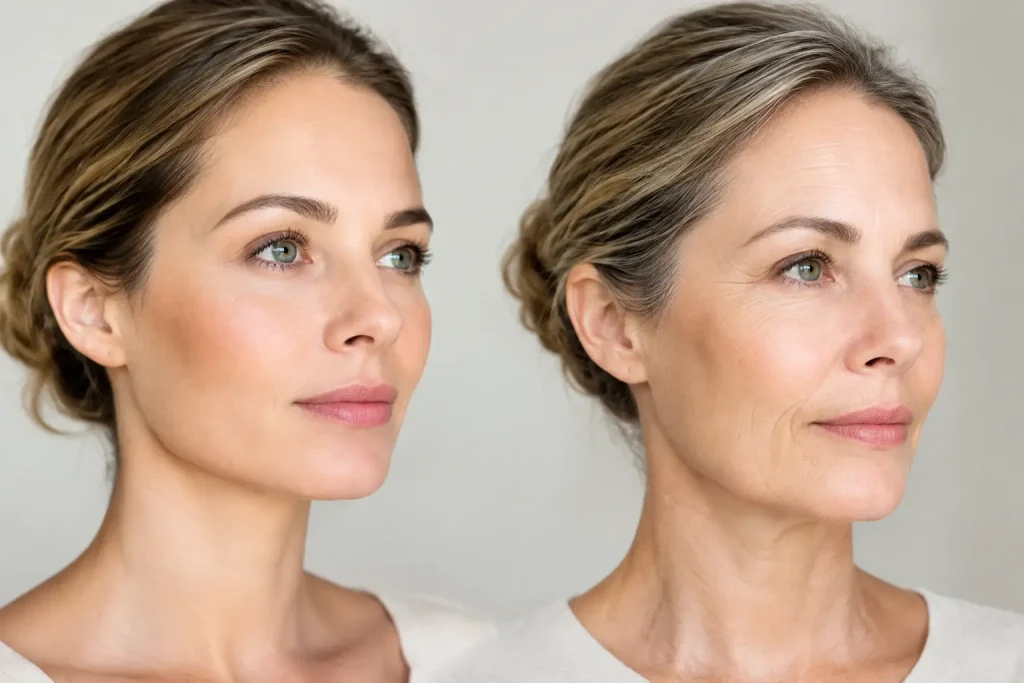
A face can appear rested and youthful even without dramatic features when the cheek has the right projection, softness, and position. With time, that balance changes. If you have wondered, why do cheeks sag with age?, the answer is not simply “loose skin.” Cheek descent is a layered structural process involving the facial skeleton, retaining ligaments, fat compartments, muscle activity, and skin quality.
This distinction matters because a refined result depends on treating the true source of change. Adding volume alone may improve one face and create an overfilled look in another. Tightening skin alone may not restore the elegant midface contour that has been lost beneath it. Facial rejuvenation is most successful when it respects both anatomy and the individual architecture of the face.
Why Do Cheeks Sag With Age? It Starts Below the Skin
The cheek is not a single structure. It is a carefully supported arrangement of bone, soft tissue, and skin. In youth, the upper cheek tends to hold volume high over the cheekbone, creating smooth transitions from the lower eyelid to the midface and from the cheek to the jawline.
As the years pass, the bony framework of the face gradually remodels. The cheekbone area, upper jaw, and eye socket can lose some of the projection that once supported the overlying tissues. This is subtle, but aesthetically significant. Soft tissue that was once well supported may begin to sit lower, flattening the upper cheek and deepening the folds around the nose and mouth.
At the same time, the skin produces less collagen and elastin. Collagen gives skin much of its firmness; elastin helps it recoil after movement. As these fibers decline and become more disorganized, the skin becomes thinner, less resilient, and less able to remain smoothly draped over the facial contours.
Facial Fat Does Not Simply Disappear
One of the most common misconceptions about facial aging is that it is only a matter of losing fat. In reality, facial fat changes in both volume and position.
The face contains distinct fat compartments rather than one uniform layer. Some compartments lose fullness, especially around the temples, upper cheeks, and under-eye area. Others may become more prominent or descend, contributing to heaviness in the lower cheek, jowls, or folds beside the mouth. The visible effect is often a shift from a softly elevated midface to a flatter, more shadowed upper cheek with greater fullness below it.
This is why a person may feel that their cheeks look “hollow and heavy” at the same time. Both observations can be true. There may be volume deficiency in the upper cheek and tissue descent in the lower cheek. A thoughtful aesthetic assessment must identify the relationship between these changes rather than treating every concern with the same amount of filler.
The Role of Retaining Ligaments
Retaining ligaments are fibrous attachments that help hold facial tissues in defined positions. Over time, these support structures can lengthen and lose some of their strength. Gravity then becomes more visible, drawing soft tissue downward and creating characteristic shadows beneath the cheekbone and around the nasolabial folds.
Gravity is not the primary cause of facial aging, but it has a cumulative effect when the foundation, fat distribution, ligaments, and skin have already changed. This is why cheek descent is usually more noticeable in the 40s and 50s, although genetics, sun exposure, weight fluctuations, and lifestyle can make it appear earlier or later.
How Skin Quality Can Make Cheek Sagging More Visible
The same degree of tissue descent can look very different depending on skin quality. Sun exposure, smoking, chronic stress, poor sleep, and repeated weight cycling can accelerate collagen loss and reduce skin elasticity. Menopause may also influence skin thickness and hydration due to hormonal changes.
When the skin is firm, it can disguise mild volume loss or descent. When it becomes thinner and more creased, shadows and folds appear sharper. Fine lines around the eyes, texture changes, enlarged pores, and a duller complexion can therefore amplify the impression of sagging cheeks, even when the underlying structural change is moderate.
For this reason, facial rejuvenation should not be viewed only as a question of lifting or filling. Skin quality is part of the composition. Treatments that support collagen production, improve texture, or address photodamage may complement volume restoration or surgical repositioning, depending on the patient’s needs.
Why Weight Changes Can Alter the Midface
Weight loss can reveal facial definition, but rapid or substantial loss may also make the cheeks appear less supported. The effect is especially apparent in individuals who already have naturally lean faces or reduced skin elasticity. A sudden reduction in facial fat may accentuate hollowness beneath the eyes, flatten the cheek, and make the lower face appear heavier by comparison.
Weight gain can have a different effect. It may increase fullness in the lower cheek and obscure the cheekbone, while the underlying descent of midface tissue remains. Neither scenario is inherently undesirable, but both can change facial proportions.
The appropriate response depends on the anatomy. A lean face with early volume loss may benefit from conservative structural volume restoration. A face with substantial tissue descent and laxity may need a lifting strategy rather than additional volume. The goal is not to create a standardized high cheekbone, but to restore a natural relationship between the eye, cheek, mouth, and jawline.
Treatment Options Depend on the Degree of Descent
For early changes, non-surgical treatments can be valuable when selected with restraint. Hyaluronic acid fillers may restore support in carefully chosen deep facial planes, helping improve upper-cheek projection and soften the transition into the lower eyelid. Biostimulatory injectables may be considered for patients seeking gradual collagen support. Energy-based treatments can be helpful for selected cases of mild laxity and skin-quality concerns.
These approaches have limits. Filler does not physically lift significantly descended tissue, and excessive use can make the midface look puffy, broad, or unnatural. A sophisticated approach prioritizes structural balance over volume for its own sake. The best result often comes from using less product in the right location.
When cheek descent, jowling, neck laxity, or deep folds are more advanced, facial surgery may offer a more durable and anatomically meaningful correction. Modern facelift techniques can reposition deeper facial layers rather than merely pulling the skin. Depending on the patient, a midface lift, deep-plane facelift, neck lift, fat grafting, eyelid surgery, or skin-resurfacing treatment may be combined to create a more harmonious outcome.
Surgery is not automatically the right answer because someone has sagging cheeks. Recovery time, skin quality, facial shape, age, medical history, and the desired degree of change all influence the decision. Conversely, a patient should not be pushed toward repeated injectables when their anatomy would be better served by a surgical solution. The art lies in choosing the least invasive approach that can genuinely achieve the intended refinement.
The Goal Is Restoration, Not a Different Face
Beautiful facial rejuvenation should preserve identity. It should not erase expression, overinflate the cheeks, or produce the artificial tension associated with outdated techniques. A well-designed treatment plan restores visual continuity: a smoother lower-eyelid-to-cheek transition, a more balanced cheek contour, softer folds, and a jawline that appears more defined because the midface is better supported.
At a consultation, an experienced facial aesthetic surgeon evaluates the face in motion as well as at rest. Frontal, oblique, and profile views reveal different aspects of cheek projection, skin laxity, under-eye hollowness, and lower-face heaviness. This analysis is essential because the feature a patient notices first is not always the area that needs primary treatment.
Cheek aging is not a flaw to be erased. It is a natural structural evolution, and it can be addressed with remarkable subtlety when anatomy, proportion, and individual character guide the plan. The most compelling results allow people to look refreshed, composed, and recognizably themselves.