

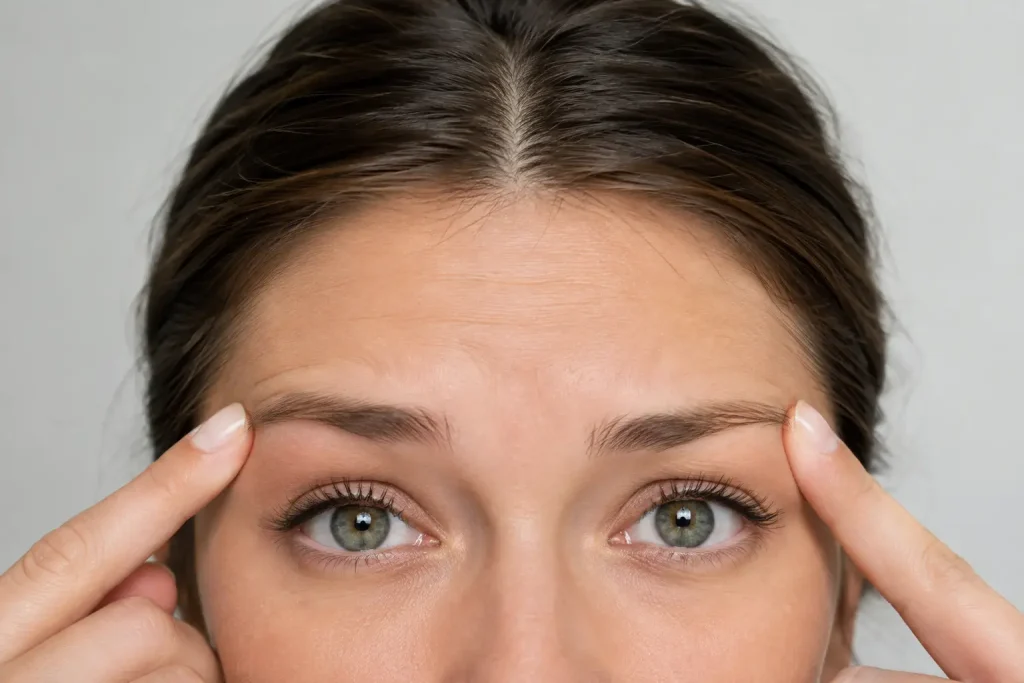
The outer brow is a small detail with a disproportionate effect on facial expression. When its tail descends, the eyes may appear tired, stern, or less open even when a person feels energetic and well rested. So, what causes the outer eyebrows to droop? Usually, it is not one isolated issue. It is the visible result of changes in skin, muscle, fat, bone structure, and individual facial anatomy.
A refined approach to brow rejuvenation begins with understanding where the change originates. The goal is not simply to lift the brow. It is to restore balance between the forehead, brow, upper eyelid, and eye shape while protecting the character of the face.
What Causes the Outer Eyebrows to Droop?
The outer third of the eyebrow, often called the brow tail, is particularly prone to descent because it has less consistent muscular support than the inner brow. The central and inner brow are influenced by forehead muscles that elevate the area. At the outer brow, the downward pull of surrounding muscles and the gradual loosening of tissues can become more visually dominant over time.
For many people, this change begins subtly in their late 30s or 40s. Others have a naturally low or flat lateral brow from adolescence. A low brow is not automatically a concern or a flaw. It becomes an aesthetic or functional consideration when it creates heaviness over the upper eyelid, changes the eye’s natural proportions, or no longer reflects how the person wishes to appear.
Natural aging and loss of tissue support
Aging affects every layer of the upper face. Collagen and elastin decline, allowing the skin and connective tissues to stretch more easily. The soft tissues that once sat higher over the orbital bone can gradually shift downward. Volume loss in the temples and upper face may also reduce the structural support that frames the outer brow.
At the same time, the bony orbit changes with age. This is not always visible in isolation, but it can alter the foundation beneath the brow and eyelid. The result is often a gradual flattening or descent of the lateral brow rather than a dramatic drop that appears overnight.
Muscle balance in the forehead and around the eyes
The position of the brow is dynamic. It changes when you speak, smile, squint, concentrate, or raise your forehead. The frontalis muscle elevates the brow, while muscles around the eyes and between the brows can pull it downward.
Over time, repeated facial expressions may deepen this imbalance. Some patients unconsciously keep the forehead muscles activated throughout the day to compensate for a heavy upper eyelid or low brow. They may notice forehead lines, fatigue around the eyes, or a feeling that they must “hold their eyes open.” When the forehead is relaxed, the true degree of brow descent may become more apparent.
This is why brow assessment should never be based on a single photograph or a brow position measured in isolation. An experienced facial aesthetic surgeon evaluates the brow at rest, in motion, and in relation to the eyelid.
Eyelid skin laxity can mimic a drooping brow
Excess upper eyelid skin, known as dermatochalasis, is commonly mistaken for a low brow. The two concerns frequently occur together, but they are not the same.
When the outer eyelid skin folds over the lash line, it can create the impression that the eyebrow has fallen. In other cases, a genuinely descended brow pushes skin downward onto the eyelid. Removing eyelid skin without recognizing brow descent may not fully address the outer heaviness. In selected patients, it can even make the brow appear lower by removing tissue that had been compensating for the position of the upper face.
The distinction matters because upper blepharoplasty and brow lifting address different anatomical concerns. A personalized plan may involve one procedure, the other, or a carefully designed combination.
Genetics and natural brow architecture
Some brows sit lower, straighter, or more horizontally by nature. Bone shape, temple volume, eyelid structure, skin thickness, and eyebrow density all influence how high or low the brow appears. A person with deep-set eyes may look different from someone with more prominent eyes even when their brow measurements are similar.
This is also why a fashionable brow shape should not be imposed on every face. A high, sharply arched brow may look elegant on one patient but artificial on another. The most successful result respects sex-specific facial features, ethnicity, age, eye shape, and the patient’s personal aesthetic.
Sun exposure, smoking, and lifestyle factors
Long-term ultraviolet exposure accelerates collagen breakdown and contributes to skin laxity around the forehead and eyelids. Smoking can have a similar effect by impairing skin quality and circulation. Major weight fluctuation may also affect facial volume and tissue support, particularly in patients who naturally have a lean upper face.
These factors do not solely cause outer brow drooping, but they can make inherited anatomy and age-related changes more noticeable. Consistent sun protection, avoiding tobacco, managing stress, and maintaining a stable weight can support skin quality, although they cannot completely reverse structural descent once it is established.
When Outer Brow Drooping Needs Medical Evaluation
Most gradual brow descent is an aesthetic and age-related concern. However, a sudden one-sided change in brow position, new facial weakness, difficulty closing an eye, speech changes, severe headache, or numbness should be evaluated urgently. These symptoms may indicate a neurological condition rather than routine facial aging.
A longstanding asymmetry is more common and often simply reflects natural facial variation. Nearly every face has some asymmetry. The question is whether it is stable, whether it affects visual comfort, and whether correction would create a more harmonious expression without making the face look overtreated.
How a Personalized Treatment Plan Is Chosen
The right treatment depends on whether the main issue is muscle activity, skin laxity, volume loss, brow descent, eyelid excess, or a combination of these factors. There is no single “best” outer brow lift because the brow is part of a larger upper-face composition.
For mild descent driven primarily by muscle pull, precisely placed neuromodulator injections may soften the muscles that draw the outer brow downward. In the right candidate, this can create a subtle opening effect. However, technique is critical. Treating the forehead too aggressively in a patient who relies on frontalis activity to elevate the brow can increase the sensation of heaviness. Injectable treatment should therefore be planned conservatively and with a detailed understanding of facial movement.
Patients with temple hollowing or loss of upper-face support may benefit from selected volumizing approaches. Strategic volume restoration can improve the transition between the forehead, temple, and brow, but it is not a substitute for lifting when tissue descent is significant. Overfilling the temple or upper face can compromise the very refinement a patient hopes to achieve.
Energy-based treatments may support skin quality and offer modest tightening for appropriate candidates. Their effect is generally more limited than surgery when the brow has noticeably descended. They may be valuable for patients who are not ready for surgery, who have early laxity, or who want to preserve the quality of a surgical result.
For more advanced lateral brow descent, surgical brow lifting may offer the most meaningful and durable correction. Contemporary techniques can be designed to elevate the outer brow with discretion, avoiding the exaggerated “surprised” appearance associated with outdated approaches. Depending on anatomy, options may include temporal, endoscopic, or other individualized lifting methods. The incision pattern, degree of elevation, and whether an upper eyelid procedure is added should be determined through direct examination rather than a standard protocol.
At Assoc. Prof. Dr. Güncel Öztürk’s practice, facial rejuvenation is approached as a matter of proportion as much as technique. The aim is to preserve a recognizable, expressive face while refining the frame around the eyes.
What a Natural Result Should Look Like
A successful correction does not announce itself as a lifted brow. The eyes appear more rested, the outer eyelid feels less crowded, and the brow sits in a position that belongs naturally to the face. The ideal degree of elevation differs considerably between patients.
Photographs can be useful during consultation, especially images from earlier adulthood that show the patient’s original brow shape and expression. Yet they are only one part of the evaluation. Skin elasticity, brow mobility, hairline position, eyelid anatomy, and healing characteristics all influence what can be achieved safely and elegantly.
If the outer brows have begun to alter the way your eyes look or feel, the most useful next step is a thoughtful upper-face assessment. A precise diagnosis can prevent an unnecessary treatment and guide a result that looks less like a change – and more like you at your most rested.