

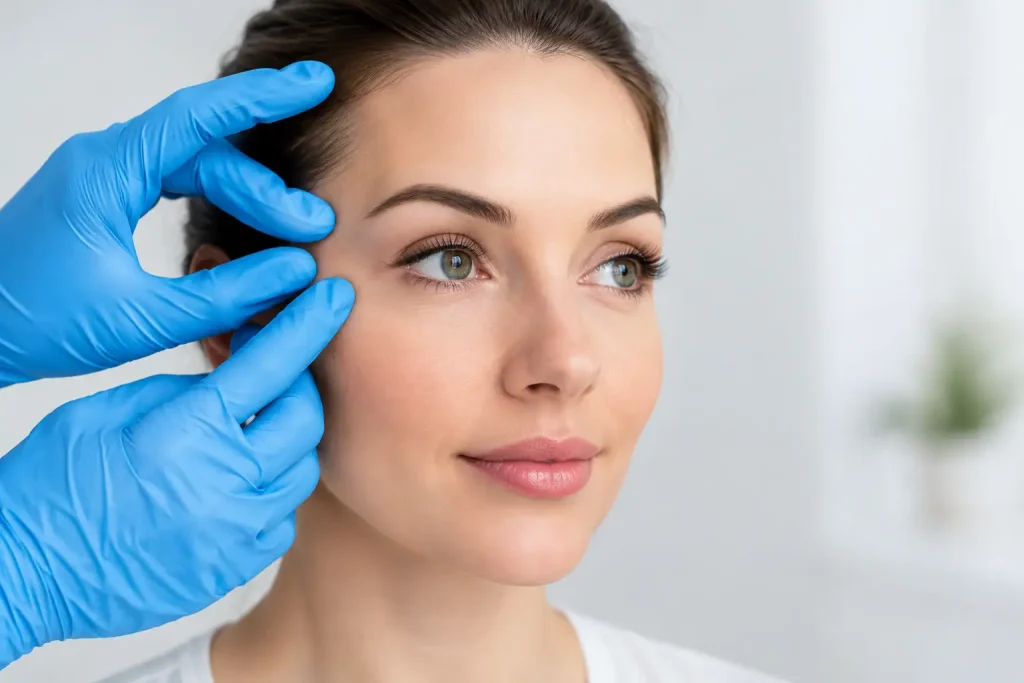
A tired or heavy-looking eye area is not always caused by the eyelids themselves. For some patients, the change begins higher on the face: the outer brow has descended, the temple has flattened, and the tail of the eye has lost its youthful lift. So, can a temporal lift change the eye area without eyelid surgery? In carefully selected cases, yes. By repositioning the lateral brow and supporting the tissues around the temple, a temporal lift can create a brighter, more open expression without removing eyelid skin.
The distinction matters. The eye area is a delicate composition of brow position, eyelid skin, orbital volume, skin quality, and facial proportions. Treating only one element when another is responsible for the concern can produce an unnatural result. A refined facial rejuvenation plan begins by identifying where the descent truly originates.
What a Temporal Lift Can Change Around the Eyes
A temporal lift, sometimes called a lateral brow lift, focuses on the outer third of the brow and the tissues at the temple. Through discreet incisions placed within the hairline, the surgeon elevates and secures these tissues in a more youthful position. The objective is not to create a surprised or exaggerated arch. It is to restore a rested, elegant frame to the eyes.
When the outer brow falls, it can create heaviness over the upper outer eyelid. Patients may describe their eyes as hooded, downturned, or less visible in photographs, even when they have only modest excess eyelid skin. Elevating the lateral brow may reduce that visual weight and reveal more of the natural upper eyelid platform.
A temporal lift can also soften the impression of a downward outer eye corner. It does not change the anatomy of the eye itself, but it can improve the relationship between the brow, temple, and outer orbital area. The result may be a fresher, more lifted-looking gaze that still appears like the patient.
For the right face, this can be one of the most sophisticated ways to refine the upper face. The change is often subtle when viewed in isolation, yet highly meaningful to overall expression.
Can a Temporal Lift Replace Eyelid Surgery?
Not always. A temporal lift and upper blepharoplasty address different anatomic concerns, although they may overlap visually.
Upper eyelid surgery removes or redistributes excess skin and, when appropriate, fat from the eyelid itself. It is generally better suited to patients with true eyelid skin redundancy, significant creasing, puffiness, or skin that folds over the lashes. A temporal lift is more appropriate when lateral brow descent is the primary source of upper-eye heaviness.
In some patients, lifting the brow reveals that the eyelid skin is not as excessive as it first appeared. In others, a brow lift alone may improve the outer eye area but leave central eyelid hooding unchanged. This is why an in-person examination is more informative than attempting to choose a procedure from a single front-facing photo.
The most natural plan may be a temporal lift alone, an upper blepharoplasty alone, or a tailored combination of both. The choice should be based on anatomy, skin elasticity, hairline position, facial balance, and the degree of correction desired. A procedure should never be selected simply because it seems less invasive or because it is trending on social media.
The Brow Position Test
During consultation, a surgeon may gently support the outer brow to assess how much of the upper-eye heaviness improves. If the eyelid opens and the lateral hooding decreases significantly, brow descent is likely contributing to the concern. If substantial loose eyelid skin remains after the brow is supported, eyelid surgery may still be beneficial.
This assessment also protects against overcorrection. Removing too much eyelid skin from a patient whose brow is low can create an overly hollow or strained appearance. Preserving the natural relationship between brow and lid is essential to an elegant result.
Who Is a Strong Candidate for a Temporal Lift?
Temporal lift candidates are often in their late 30s to 50s, although age alone does not determine suitability. Some younger patients have a naturally low lateral brow or early temple descent that makes their eye area appear heavy. Others seek a refined restoration rather than a dramatic change.
The ideal candidate typically has lateral brow descent, mild to moderate outer eyelid hooding, and realistic expectations about what a lift can accomplish. Good skin quality and a stable hairline are also relevant, because incision planning should respect the individual’s hair-bearing scalp and facial proportions.
Patients with pronounced excess upper eyelid skin, severe brow ptosis, marked forehead laxity, or significant under-eye concerns may need a different approach. Lower eyelid bags, tear trough hollowing, and crepey lower-lid skin are not corrected by a temporal lift. Depending on the concern, options may include lower blepharoplasty, fat repositioning, regenerative treatments, or carefully selected volume restoration.
A high-level consultation should consider the face as a whole. Temple volume, cheek projection, eyebrow shape, eyelid symmetry, and the natural direction of the eye all influence the final design. In artistic facial surgery, a lifted brow is not a goal on its own. It must belong to the individual face.
The Role of Temple Volume and Skin Quality
Not every change around the eye requires surgery. Loss of volume at the temples can make the lateral brow appear less supported and can deepen the transition between the forehead and upper face. In select patients, structural volumization or regenerative treatments may complement a temporal lift or offer a nonsurgical option when tissue descent is minimal.
These treatments have limits. Injectable treatments can improve contour and support, but they cannot remove substantial skin excess or reproduce the structural repositioning achieved with surgery. Likewise, energy-based skin treatments may improve texture and fine lines, but they do not reliably lift a descended brow.
The strongest treatment plan is usually the one that does the least necessary, not the one that includes the most procedures. An eye area can look overtreated quickly when volume, lifting, and skin tightening are applied without a clear aesthetic hierarchy.
Recovery and Results: What to Expect
Recovery after a temporal lift varies according to the technique used and whether it is combined with other procedures. Swelling, tightness, bruising, and temporary changes in sensation around the temple or scalp are common in the early healing period. Most visible bruising improves within one to two weeks, while subtle swelling can continue to settle for several weeks.
The initial appearance may look more elevated than the final result. As the tissues relax and heal, the brow position becomes more natural. Final refinement takes time, particularly in photographs and close-up expressions.
Scars are typically designed within the hairline, but scar quality depends on healing, incision care, skin type, and surgical technique. Hairline preservation deserves particular attention in patients with fine hair, a high forehead, or a history of hair thinning. These details are not minor technical points. They directly shape whether the result remains discreet.
At Assoc. Prof. Dr. Güncel Öztürk’s practice, facial procedures are approached through individualized analysis rather than a fixed template. The aim is to preserve the patient’s identity while refining the architecture that frames the eyes.
Questions Worth Asking at Consultation
A thoughtful consultation should clarify whether your concern comes from brow descent, eyelid excess, volume loss, or a combination of factors. Ask how the surgeon evaluates brow position, where incisions will be placed, whether eyelid surgery is likely to be necessary later, and what degree of lift is realistic for your anatomy.
It is also reasonable to ask to see results in patients with a similar brow shape, hairline, and degree of eyelid hooding. Before-and-after images should demonstrate more than a higher brow. Look for eyes that appear rested, balanced, and expressive without an artificial pull.
A temporal lift can be a powerful alternative to eyelid surgery when the outer brow, rather than the eyelid, is the source of heaviness. The most beautiful outcome is rarely the most obvious one. It is the result that lets the eyes look more awake while preserving the expression that makes the face unmistakably your own.