

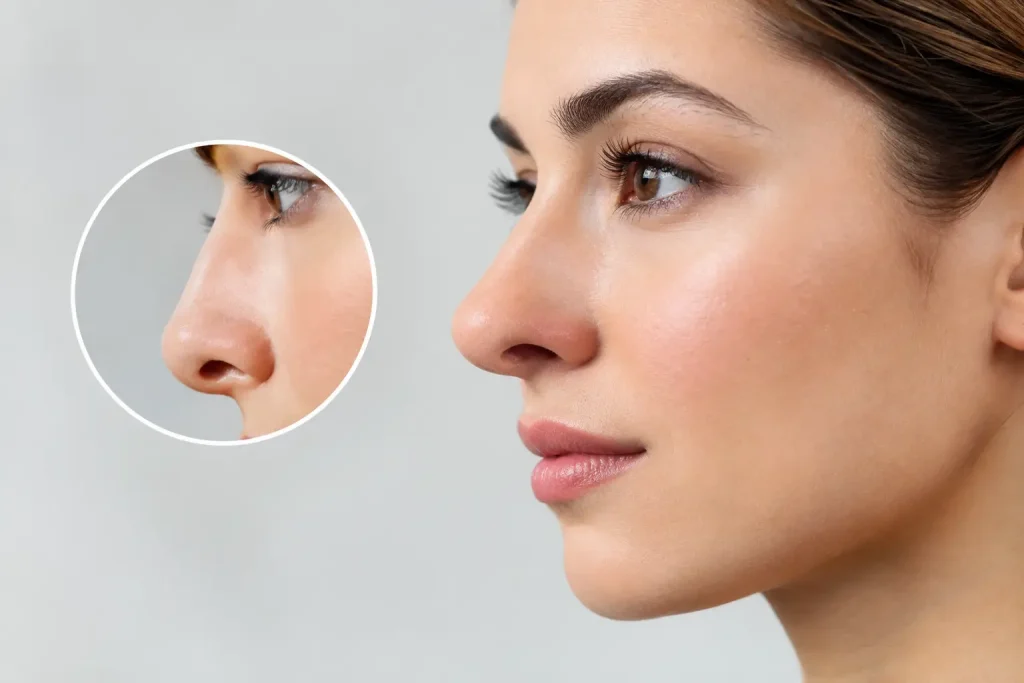
A nasal tip can appear refined and lifted in a photograph, then look noticeably lower when a person smiles, speaks, or is seen in profile. For patients considering rhinoplasty, the question, “what causes a droopy nasal tip?” is rarely only about one feature. Tip position influences the perceived length of the nose, the balance between the nose and upper lip, and the character of the entire facial profile.
A droopy tip is not always a sign of aging, nor is it always the result of a single structural issue. It may be present from birth, develop gradually as support changes over time, follow trauma, or emerge after an earlier nasal operation. A precise diagnosis matters because a tip that drops at rest requires a different approach than a tip that descends mainly with facial expression.
What Causes a Droopy Nasal Tip?
The nasal tip is supported by a delicate architectural system of cartilage, ligaments, skin, and soft tissue. When one or more parts of this system are long, weak, displaced, or affected by time, the tip may rotate downward. In aesthetic terms, surgeons assess both tip projection, meaning how far the tip extends from the face, and tip rotation, meaning its upward or downward angle.
A lower tip can make the nose appear longer even when nasal length is proportionate. It can also reduce the visibility of the nostrils from the front and create a heavier impression at the center of the face. Yet a slightly downward-oriented tip is not inherently unattractive. The ideal degree of rotation depends on facial proportions, sex, ethnicity, skin thickness, and the individual’s aesthetic goals. The objective is not an over-rotated or identical-looking nose, but a tip position that belongs naturally to the face.
Inherited cartilage shape and nasal anatomy
For many patients, a droopy tip is simply part of their natural anatomy. The lower lateral cartilages, which help shape the tip and nostrils, may have a downward curve. The central septal cartilage may be relatively long, pulling the visual axis of the nose downward. Some patients also have a prominent nasal spine or a strong connection between the tip and upper lip that contributes to a lowered appearance.
Skin thickness changes how these structures are seen. Thick skin can soften tip definition and make a mildly downward cartilage shape appear heavier. Thin skin, by contrast, may reveal even small asymmetries or changes in cartilage contour. This is why a photograph alone cannot define the appropriate surgical plan. The visible tip is only the surface expression of an underlying structure.
Weak or altered tip support
The nasal tip does not remain in position because of cartilage alone. It depends on ligamentous attachments and the relationship between the tip cartilages and septum. When this support is naturally weak, the tip may lack elevation and stability, particularly from the side view.
Support can also be compromised after injury or surgery. A fracture may alter the alignment of the septum or the cartilages that shape the tip. In some cases, previous rhinoplasty removed too much cartilage or disrupted supporting structures without adequately rebuilding them. The resulting concern may be a tip that looks lower over time, lacks definition, or appears to collapse slightly during breathing.
Revision rhinoplasty demands particular judgment because scar tissue, altered anatomy, and limited cartilage reserves may all be present. Rather than simply lifting the tip, the surgeon must understand which structural relationships have changed and reconstruct support in a controlled, proportionate way.
The muscle that pulls the tip down when smiling
Some nasal tips appear well positioned at rest but drop noticeably during smiling. This is often related to the depressor septi nasi muscle, a small muscle that connects the base of the nose to the upper lip. In certain facial expressions, it can pull the nasal tip downward and shorten the appearance of the upper lip.
This dynamic movement is one reason an in-person consultation should include observation while the patient smiles, talks, and relaxes. A static profile image may not reveal the concern that bothers a patient most in real life. Dynamic tip descent can sometimes be addressed with a targeted surgical technique during rhinoplasty. In carefully selected cases, neuromodulator treatment may reduce muscle activity temporarily, although it cannot correct a structural droop or replace surgical support when that is needed.
Aging and changes in soft tissue
Aging can contribute to a downward shift in the nasal tip, especially when preexisting support is modest. Over the years, the skin and soft tissues lose some elasticity, while gravity and facial volume changes alter how the nose relates to the cheeks, lips, and chin. The tip may appear less elevated, more projected, or less defined than it did earlier in life.
Cartilage itself also changes with age. It does not simply grow in a straightforward way, but it can lose resilience and become less capable of maintaining its earlier shape. For some people, this creates a subtle change; for others, it becomes a defining concern in profile photographs.
Aging rarely affects the nose in isolation. A retrusive chin, upper-lip changes, or midface volume loss can make a nasal tip seem more prominent or lower than it truly is. Sophisticated facial analysis considers these relationships before recommending an intervention.
When a Droopy Tip May Be a Functional Concern
A low nasal tip can be entirely aesthetic, but in some cases it is associated with breathing concerns. Weak tip support, narrowed nostrils, or collapse of the nasal valves can make airflow feel restricted, particularly during exercise or deep inhalation. Patients may notice that the nostrils pull inward, or that they need to lift the tip slightly to breathe more comfortably.
Not every droopy tip causes obstruction, and not every breathing complaint originates at the tip. Septal deviation, turbinate enlargement, allergies, and prior injury can all contribute. A thorough assessment should separate visual goals from functional findings so that nasal refinement does not come at the expense of stable airflow.
How Surgeons Assess Tip Position
A refined rhinoplasty plan begins with more than identifying a downward angle. The surgeon studies the nose from the front, oblique, base, and profile views, then evaluates the internal structures and the nose in motion. Facial balance is equally important. A tip that appears low beside a prominent dorsal hump may look appropriately rotated once the bridge is refined. Conversely, raising the tip without addressing disproportion elsewhere can create an artificial result.
Three-dimensional planning can be useful for discussing possible changes and aligning expectations, particularly for patients traveling internationally. Still, simulation is a communication tool, not a guarantee. Skin behavior, healing patterns, scar formation, and the integrity of the patient’s own tissues all influence the final result.
For a patient with a genuinely under-rotated tip, surgery may involve reshaping the lower lateral cartilages, adjusting the caudal septum, releasing a strong depressor muscle when indicated, and using cartilage grafts to reinforce the desired structure. The exact combination depends on the anatomy. Over-rotating the tip or relying on excessive cartilage removal can lead to a pinched appearance, visible nostrils, or long-term instability.
Choosing Correction With a Long-Term View
The most elegant correction is rarely the most dramatic one. A well-designed nasal tip should remain expressive, preserve or improve breathing where possible, and retain its relationship to the rest of the face as swelling resolves. This is especially relevant for thick-skinned noses, revision cases, and patients with significant asymmetry, where refinement may occur gradually over many months.
At a consultation, patients benefit from discussing what they notice in the mirror and in motion: whether the tip looks low only when smiling, whether they dislike a long profile, whether breathing changes with exercise, and whether they have had prior trauma or surgery. These details help transform a broad aesthetic concern into a thoughtful structural plan.
In the hands of an experienced rhinoplasty specialist, tip refinement is not about imposing a fashionable angle. It is about restoring proportion, support, and a sense that the nose has always belonged to the face.