



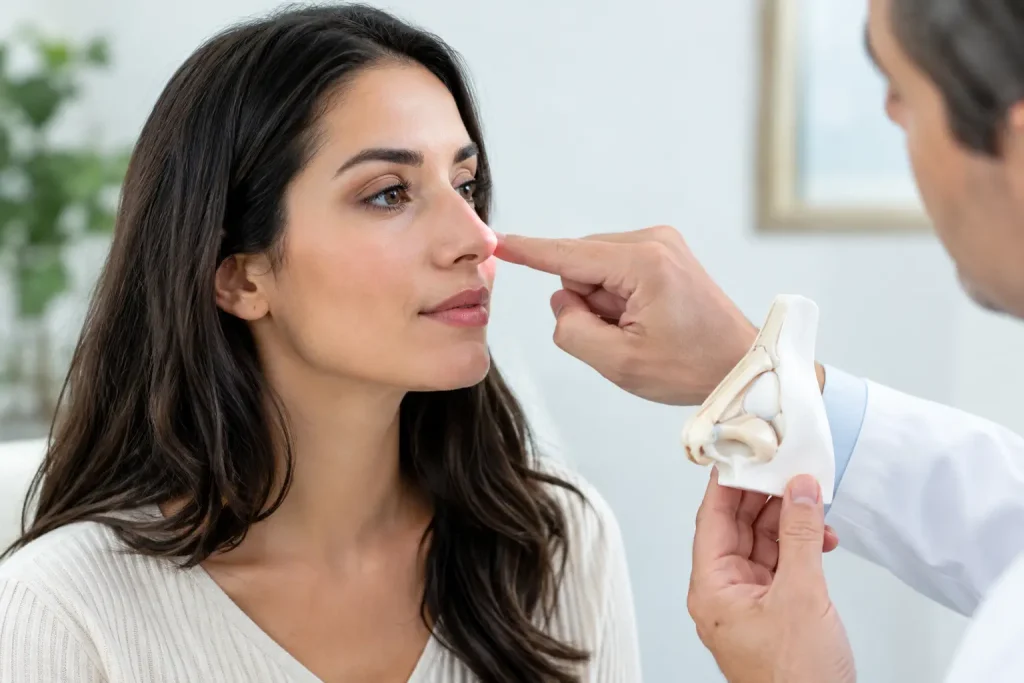
A refined rhinoplasty result is not created by reshaping cartilage alone. The skin that covers the nasal framework determines how clearly each structural change will appear, how much support is required, and how patiently the final contour must be allowed to emerge. For patients asking how does skin thickness affect rhinoplasty planning and healing?, the answer begins with a central principle of aesthetic surgery: the same surgical maneuver can look entirely different beneath different skin envelopes.
In a design-led rhinoplasty, skin thickness is assessed before any incision is made. It is part of the anatomy, but it is also part of the visual language of the face. A beautiful result is not simply a smaller nose or a sharper tip. It is a stable, harmonious nasal form that works with the patient’s facial proportions, skin quality, ethnicity, and long-term healing biology.
How Skin Thickness Affects Rhinoplasty Planning
The nasal skin and its underlying soft tissue form the envelope over bone and cartilage. This envelope can be thin, medium, thick, oily, scar-prone, or uneven in thickness from the bridge to the tip. Most noses do not fit neatly into a single category. A patient may have relatively thin skin over the upper bridge and thicker, more sebaceous skin around the tip and nostrils.
During consultation, the surgeon evaluates skin texture, pore size, oil production, elasticity, thickness at different nasal levels, and the strength of the cartilage underneath. This analysis is combined with profile and frontal examination, facial balance, breathing function, and, when appropriate, 3D planning and simulation. The goal is not to promise an identical image from a simulation. It is to create a surgical plan that respects what the skin can naturally reveal.
Thin skin reveals structure
Thin nasal skin can be highly responsive to subtle structural refinement. Fine changes to the bridge, tip definition, and nasal angles may become visible with exceptional clarity. For the right patient, this can support an elegant, sculpted result with delicate transitions of light and shadow.
The trade-off is that thin skin is less forgiving. Minor irregularities in cartilage, bone, graft edges, or asymmetry can become more apparent as swelling resolves. For this reason, the surgical approach must be especially precise. Controlled osteotomies, smooth contour transitions, careful cartilage shaping, and strategic camouflage techniques may be used to avoid a result that appears overly sharp or surgically apparent.
Thin skin also requires restraint. An aggressive reduction can leave too little soft-tissue coverage over the framework, making the nose look unnatural over time. A sophisticated result often comes from preserving support and creating refinement through measured, structurally sound changes rather than excessive removal.
Thick skin softens detail
Thicker skin tends to diffuse the contours beneath it. This can be advantageous when concealing tiny skeletal irregularities, but it can make fine tip definition more challenging. Even beautifully shaped cartilage may not immediately project through a thicker skin envelope with the same level of crispness seen in thinner-skinned patients.
For this reason, planning for thick skin often emphasizes strong, balanced internal architecture. Rather than relying on cartilage reduction alone, the surgeon may refine and support the nasal tip so it has the projection and definition needed to be visible through the overlying tissue. Structural grafting, suture techniques, and preservation of key support mechanisms may play an important role, depending on the patient’s anatomy and the goals of surgery.
The artistic question is not whether a thick-skinned nose can become elegant. It can. The question is what kind of elegance is realistic and harmonious. A natural-looking result may favor a refined, well-supported tip and a graceful bridge over an excessively narrow or pinched appearance that the skin cannot convincingly display.
Skin quality matters alongside thickness
Thickness is only one part of the equation. Oily skin, enlarged pores, acne scarring, sun damage, and reduced elasticity can influence both planning and healing. A firm, thick skin envelope may contract differently than a softer, more elastic one. Previous surgery can also change the soft tissues through scar formation, which is why revision rhinoplasty requires particularly detailed analysis.
In some cases, a patient’s skin characteristics suggest that a staged approach to aesthetic expectations is best. The early result may look broader or less defined than the long-term outcome, especially at the tip. This is not necessarily a sign that the operation has failed. It is often the normal visual effect of swelling within a thicker soft-tissue envelope.
Healing Timelines for Thin and Thick Nasal Skin
Every rhinoplasty heals in phases. Initial swelling and bruising improve substantially in the first weeks, but the nose continues to settle for many months. Skin thickness can influence how that process looks and feels.
Patients with thinner skin may begin to see structural details earlier as swelling decreases. Yet they can also notice small contour changes during healing that are not final. A temporary area of firmness, uneven swelling, or shadowing may be more visible simply because the skin is more transparent to the underlying structure.
Patients with thicker skin often need more patience, particularly in the nasal tip. Swelling can persist longer because the soft tissue is more substantial and may retain fluid more readily. Tip refinement may continue to emerge gradually over 12 months, and sometimes longer in complex cases. A nose that seems rounded early in recovery can become more defined as the skin envelope contracts and adapts to its new framework.
This distinction is why the first months after surgery should not be judged through a daily mirror inspection. Healing is not linear. One week can look more refined than the next, particularly after travel, exercise, salt intake, hormonal changes, or insufficient rest. Postoperative photographs taken at planned intervals provide a more meaningful view of progress than moment-to-moment comparison.
Swelling management is individualized
Postoperative taping may be recommended for selected patients, especially where persistent tip swelling is anticipated. In certain cases, a surgeon may consider targeted treatments for prolonged scar tissue or edema. These decisions are not routine extras and should not be copied from another patient’s recovery plan. They depend on the skin, the surgical technique, the degree of swelling, and the stage of healing.
Patients can support a more predictable recovery by following aftercare instructions closely, protecting the nose from trauma and sun exposure, avoiding smoking, maintaining a stable routine, and attending scheduled follow-up appointments. These measures do not replace biology, but they help preserve the conditions for healthy healing.
Why a One-Size-Fits-All Nose Design Fails
A reference photograph can communicate preferences, but it cannot serve as a blueprint. A narrow, highly defined tip seen on one face may depend on thin skin, strong cartilage, specific facial proportions, and a unique healing response. Reproducing that shape indiscriminately may compromise natural appearance or nasal function in another patient.
This is where rhinoplasty becomes both technical and artistic. The surgeon must interpret the patient’s desired aesthetic through the reality of their tissues. A well-planned nose should look intentional without looking imposed. It should retain strength for breathing, maintain proportion from every angle, and age gracefully within the face.
At Dr. Güncel Öztürk’s practice, this individualized evaluation is central to the Nose Art philosophy: designing the nasal form as a refined part of the whole face, rather than treating it as an isolated feature. Skin thickness is not a limitation to overcome. It is one of the materials that shapes the final composition.
Questions to Discuss Before Rhinoplasty
Before committing to surgery, ask how your skin quality affects tip definition, bridge refinement, expected swelling, and the realistic timeline for seeing a settled result. It is also wise to discuss whether your nose needs added structural support, whether prior surgery or trauma has altered the tissues, and how breathing concerns will be protected during aesthetic reshaping.
The most valuable consultation does not offer a generic promise of a smaller or sharper nose. It provides a thoughtful explanation of what your own anatomy can support and why. When the surgical plan respects the relationship between skin, cartilage, bone, and facial balance, patience in recovery becomes easier to understand – and the final result has the best opportunity to look quietly, convincingly your own.