



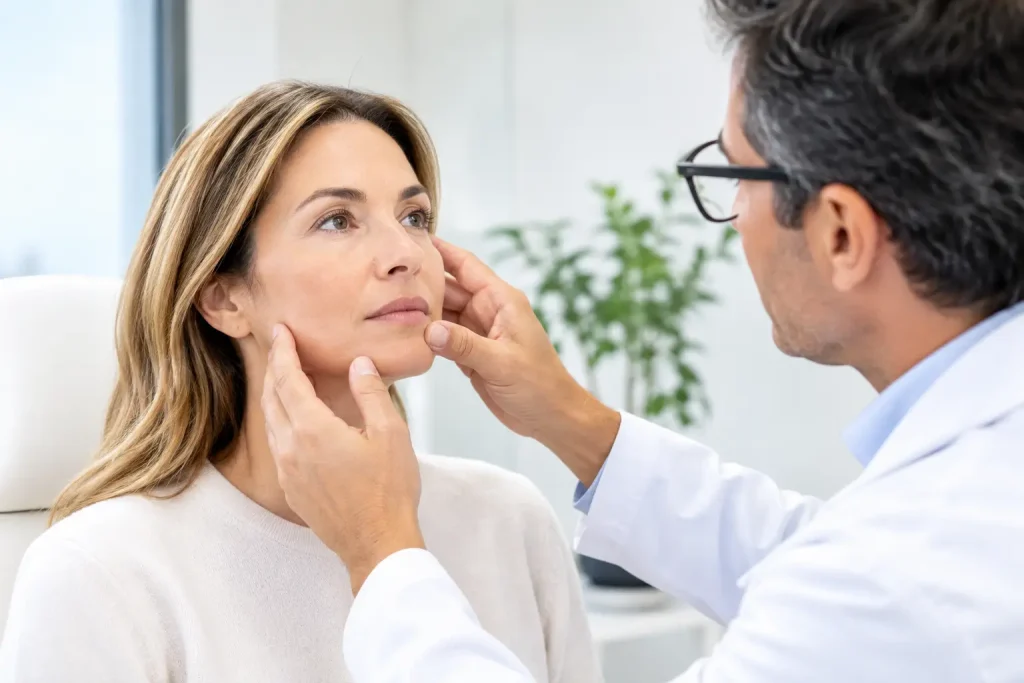
A patient may arrive asking for a facelift because of deep folds around the mouth, tired eyes, or a less-defined jawline. Yet those visible concerns can arise from very different structural changes. Patients often ask, “How do surgeons assess facial aging before recommending surgery?” The answer is not a quick glance at wrinkles. It is a careful study of the face as a living composition: bone, fat, muscle, ligaments, skin, expression, proportion, and the way each element has changed over time.
A sophisticated facial rejuvenation plan begins with diagnosis rather than a procedure name. The goal is not to make every line disappear. It is to identify what has altered the face’s harmony, then determine whether surgical refinement, a nonsurgical treatment, or no intervention at all offers the most appropriate path.
Facial aging is more than loose skin
The face does not age in a single direction. Some areas lose volume, while others appear heavier. The temples and cheeks may become hollow as the lower face develops jowling. The jawline may soften, while the neck shows laxity beneath the chin. Skin texture changes at the same time, but it is rarely the only issue.
Surgeons assess aging across several anatomical layers. Skeletal support can gradually recede with age, especially around the orbit, midface, and jaw. Facial fat compartments may deflate, descend, or become more visible in selected areas. Retaining ligaments can create shadows and folds as surrounding tissues shift. Muscle activity contributes to expression lines, and the skin loses collagen, elasticity, and luminosity.
This distinction matters because treating surface laxity alone may not correct volume loss or deeper descent. Conversely, adding volume to a face with significant tissue heaviness can create an overfilled appearance. Refined rejuvenation depends on recognizing which layer is driving the concern.
How do surgeons assess facial aging before surgery
The consultation starts with listening. A surgeon asks what the patient sees in photographs, mirrors, and video calls, but also what they hope others will notice after treatment. Some patients want to look less fatigued without appearing altered. Others are concerned by a specific change, such as neck laxity or heavy upper eyelids. These goals establish an aesthetic direction, but they must be considered alongside anatomy and safety.
A full medical history is equally essential. Previous facial surgery, injectable treatments, weight changes, smoking, medications, autoimmune conditions, bleeding risk, and healing history can all influence a recommendation. A procedure that is appropriate for one patient may carry different risks or limitations for another.
The physical examination then evaluates the face in balance rather than as isolated zones. The surgeon observes the forehead, brows, eyelids, cheeks, nose, lips, jawline, chin, and neck from the front, three-quarter view, and profile. Facial asymmetry is documented with care. Almost every face has natural asymmetry, and recognizing it before surgery helps create realistic expectations afterward.
Proportion, contour, and the facial frame
Aging can reveal itself through changing proportions. The youthful face often has smooth transitions between the lower eyelid and cheek, cheek and jawline, and jawline and neck. With time, those transitions may become more segmented by hollows, folds, bulges, or shadows.
The surgeon evaluates whether the cheek has lost projection, whether nasolabial folds are caused by descent or volume change, and whether the chin provides sufficient support for the lower face. A weak chin, for example, may make jowling or neck fullness appear more pronounced. Addressing that structural relationship can sometimes improve the overall result more elegantly than focusing on one line alone.
The neck is assessed as part of the facial frame, not as an afterthought. Skin quality, platysma banding, submental fat, gland prominence, and jawline definition each affect whether a facelift, neck lift, liposuction, or a combination approach may be considered.
Skin quality and the limits of surgery
Facelift surgery can reposition deeper tissues and remove selected excess skin. It cannot, by itself, fully erase sun damage, enlarged pores, fine etched lines, pigmentation, or textural irregularities. For this reason, a detailed assessment includes skin thickness, elasticity, photodamage, hydration, and healing potential.
Thin, fragile skin may require a more conservative approach to tension and incision planning. Thick or sebaceous skin may behave differently around the jawline and neck. In some cases, medical-grade skincare, laser-based treatments, regenerative approaches, or injectables may be discussed before or after surgery to improve the skin’s surface quality. These treatments complement surgery when indicated; they do not replace structural correction when laxity and descent are advanced.
Dynamic movement matters
A face is never static. The surgeon observes the patient speaking, smiling, raising the brows, and gently closing the eyes. This reveals how muscle movement influences forehead lines, crow’s feet, downturned mouth corners, neck bands, and lower-face tension.
Dynamic assessment is particularly relevant around the brow and eyelids. A low brow can create the impression of excess upper-eyelid skin, while true eyelid hooding may require a different solution. Treating the eyelids without considering brow position can compromise both aesthetics and function. The same principle applies throughout the face: the visible concern may not originate where it appears.
Photography, imaging, and aesthetic planning
Standardized photographs are a central part of responsible facial assessment. Consistent lighting, head position, and angles allow the surgeon and patient to study contour, symmetry, and progression over time. They also create a reliable reference for surgical planning and postoperative evaluation.
Advanced 3D imaging and simulation can add another dimension to the conversation. They may help patients understand proportional relationships and visualize the intended direction of refinement. At a practice such as Assoc. Prof. Dr. Güncel Öztürk’s, where artistic judgment is paired with advanced planning, technology can support a more considered design process.
Simulation, however, is not a guarantee. It is an educational planning tool, not a promise of an identical surgical outcome. Skin behavior, healing response, scar maturation, and the limits of anatomy remain individual. A credible consultation makes room for those realities rather than presenting rejuvenation as a fixed digital result.
Deciding whether surgery is the right recommendation
After the assessment, the surgeon weighs the degree of tissue descent, volume loss, skin quality, and the patient’s goals against the expected benefit and recovery involved. Mild early changes may respond well to nonsurgical options such as neuromodulators, carefully placed filler, biostimulating treatments, energy-based procedures, or skin renewal protocols. These can be valuable when used with restraint and anatomical precision.
Surgery becomes more compelling when there is substantial laxity in the lower face and neck, advanced jowling, pronounced platysma changes, or eyelid and brow changes that cannot be meaningfully corrected with injectables. For some patients, a deep-plane facelift, neck lift, brow lift, or blepharoplasty may be discussed. For others, a staged strategy is wiser.
The trade-off is clear: surgery can offer more structural and enduring correction, but it requires downtime, incisions, anesthesia considerations, and a measured healing period. Nonsurgical treatments are less invasive and may involve less recovery, but their effect is typically more limited and temporary. The correct choice depends on the individual face, not on a trend or a calendar age.
The value of a personalized, conservative eye
The most convincing facial rejuvenation does not announce itself. It preserves the patient’s character, expression, and recognizable beauty while reducing the visual signals of fatigue or tissue descent. That requires technical skill, but also aesthetic restraint.
A trustworthy surgeon may recommend less than a patient expected, postpone surgery until the timing is better, or advise against a procedure that would not deliver a meaningful improvement. This judgment is part of premium care. The objective is not to perform the most procedures. It is to create a result that remains balanced in motion, in photographs, and in the patient’s daily life.
The right consultation should leave you with more than a menu of treatments. It should give you a clear understanding of what your face needs, what it does not need, and why a particular plan respects the person you already are.