



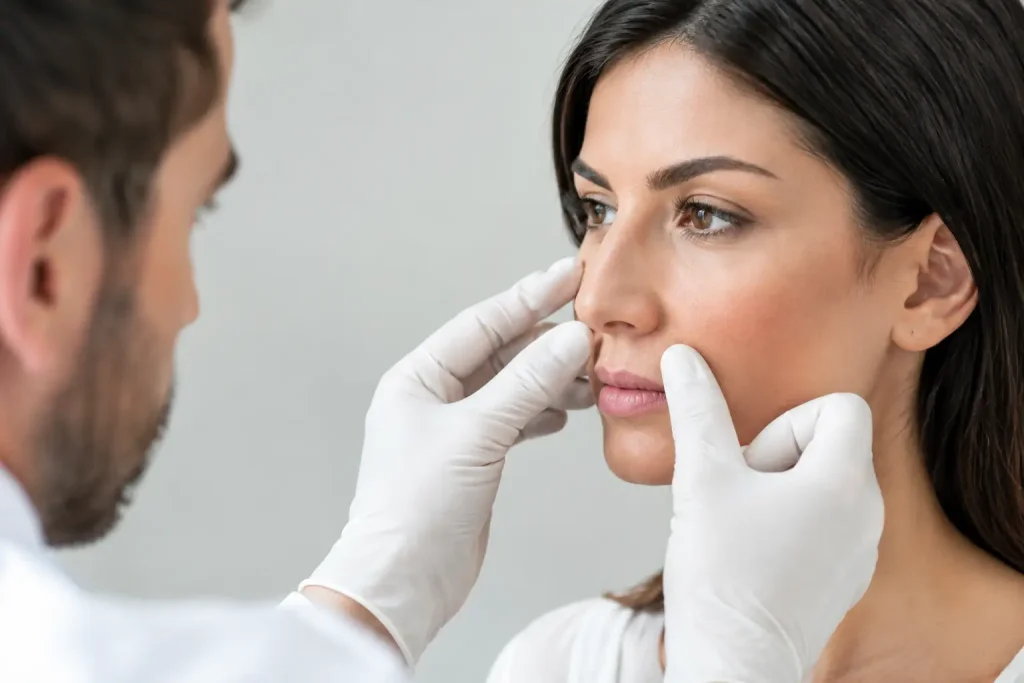
A nose can appear crooked for many different reasons: a childhood injury, a sports impact, uneven cartilage growth, a deviated septum, or changes left by previous nasal surgery. For patients asking, “eğri burun estetik ameliyatla düzelir mi?”, the answer is usually yes, but correction requires more than simply making the bridge look straighter. Successful rhinoplasty must address the nasal framework beneath the skin while preserving, or improving, comfortable breathing.
A refined result is not a perfectly geometric nose viewed in isolation. It is a nose that follows the face naturally, respects the patient’s character, and remains structurally stable as healing progresses. This is why crooked nose surgery is among the more technically demanding areas of rhinoplasty.
Can a Crooked Nose Be Corrected With Rhinoplasty?
Rhinoplasty can correct many forms of visible nasal deviation. The operation may straighten the nasal bridge, improve asymmetry at the tip, narrow or rebalance the nasal bones, and address a septum that pulls the nose off center. In patients whose crooked appearance is caused by trauma, surgery can also restore support that was weakened or displaced by the injury.
However, “crooked” is not a single diagnosis. One patient may have a bridge that bends to one side, while another has a relatively straight bridge but a tip that turns in the opposite direction. In more complex cases, the upper third, middle vault, tip cartilage, and septum may each deviate differently. The surgical plan must identify where the imbalance begins rather than treating every nose with the same technique.
The goal is controlled refinement, not excessive removal. Removing too much cartilage or bone may initially seem to create a straighter contour, but it can compromise support and contribute to collapse, pinching, or recurrent asymmetry over time. A structurally planned rhinoplasty uses reshaping, repositioning, and, when needed, cartilage grafting to create a more balanced architecture.
Why Straightening a Nose Requires Structural Precision
The nose is a three-dimensional structure with skin, bone, cartilage, ligaments, and an internal airway. A deviation visible from the front may originate deep within the septum. If the internal support is not corrected, an outwardly improved nose can remain unstable or continue to look asymmetric as swelling resolves.
For this reason, crooked nose rhinoplasty often includes septoplasty. Septoplasty corrects the internal septum, the wall dividing the nasal passages. Rhinoplasty reshapes the external form. These procedures may be performed together when both breathing and appearance are affected, but they serve different purposes. A detailed examination clarifies whether the concern is cosmetic, functional, or both.
During surgery, the nasal bones may be precisely mobilized and repositioned to improve alignment. The middle part of the nose may require spreader grafts or other support techniques to maintain width and airflow. A twisted tip can require careful cartilage modification, suturing, or support grafts. In patients with prior surgery or significant trauma, septal cartilage may be insufficient, making cartilage from the ear or rib a considered option.
Each decision carries a trade-off. Greater correction may require more extensive structural work and a longer period of swelling. A nose with naturally thicker skin may reveal definition more gradually than a nose with thin skin. Severe preexisting asymmetry can improve dramatically, yet a trace of asymmetry may remain because faces, skin envelopes, and healing responses are not perfectly symmetrical.
The Consultation: Designing for the Face, Not a Template
A premium rhinoplasty consultation should begin with analysis rather than a predetermined nose shape. The surgeon evaluates the nose from the front, profile, base, and oblique angles, while also assessing facial proportions, chin projection, skin thickness, prior trauma, and breathing quality. This broader perspective matters because a nose may look crooked partly due to surrounding facial asymmetry.
High-resolution photography and 3D planning can make this discussion more precise. Digital simulation is valuable for communicating aesthetic direction and identifying realistic proportions. It is not a promise or a final blueprint, since living tissue heals differently than an image on a screen. Its real value lies in creating shared expectations between patient and surgeon before the procedure.
At Assoc. Prof. Dr. Güncel Öztürk’s practice, this design-led approach reflects the principle that nasal surgery is both reconstructive engineering and facial art. The most persuasive result rarely announces that surgery has taken place. It allows the eyes, expression, and overall facial harmony to take precedence.
What a Surgeon Will Assess
Before recommending surgery, the surgeon should determine whether the deviation is stable, whether nasal obstruction is present, and whether a prior operation has altered the available cartilage. A patient with a recent nasal fracture may need to wait until tissues settle before pursuing definitive rhinoplasty. Someone with allergies or chronic congestion may also need medical management alongside structural correction.
The quality of the skin envelope deserves equal attention. Skin does not shrink around a newly shaped framework at the same rate for every patient. Thick or scarred skin may limit how sharply small details appear, while very thin skin can expose minor irregularities. A thoughtful plan accounts for these realities instead of promising an artificial level of perfection.
What Recovery Looks Like After Crooked Nose Surgery
Most patients wear a nasal splint for approximately one week. Bruising and visible swelling are usually most apparent during the first one to two weeks, although the exact course varies. Many people feel ready to return to social routines after this initial period, particularly with light makeup if appropriate, but the nose is still early in its recovery.
The bridge often begins to look straighter before the tip fully settles. Tip swelling can persist for months, particularly after substantial structural correction or in patients with thicker skin. Subtle refinement commonly continues for up to a year, and occasionally longer in complex revision cases. Patience is part of the treatment plan, not an afterthought.
Breathing may feel temporarily restricted in the early weeks because of internal swelling. As tissues heal, airflow generally improves when an obstructive septal deviation has been corrected, though outcomes depend on the condition of the nasal lining, turbinates, allergies, and any prior scarring. Follow-up visits allow the surgeon to monitor both appearance and function throughout this process.
Patients can support a smoother recovery by protecting the nose from impact, avoiding strenuous exercise until cleared, sleeping with the head elevated early on, and following all instructions regarding taping, cleansing, and medications. Glasses may need special management while the nasal bones heal. These details are small, but they protect the precision achieved in surgery.
When Revision Rhinoplasty May Be Necessary
Primary crooked nose surgery is challenging because the nose has a natural tendency to return toward its original shape during healing. Cartilage has memory, scar tissue can contract, and uneven skin swelling can temporarily exaggerate asymmetry. These are recognized biological realities, not necessarily signs of a poorly performed procedure.
Revision rhinoplasty is considered only after adequate healing, usually around one year after the initial operation unless there is a significant functional issue that requires earlier attention. Revision surgery demands even more careful planning because cartilage reserves may be limited and scar tissue can alter tissue behavior. Selecting a surgeon experienced in both primary and revision structural rhinoplasty is particularly valuable for noses affected by trauma or previous surgery.
Choosing the Right Expectation
The best candidates for crooked nose rhinoplasty are not seeking mathematical symmetry. They want the nose to look more centered, balanced, and harmonious while retaining strength and natural movement. Clear goals may include correcting a visible bend, softening a twisted tip, improving a post-traumatic contour, or breathing more freely through the nose.
Photographs of previous work can help patients understand a surgeon’s aesthetic judgment, especially in front-view corrections where subtlety and consistency matter. Yet another patient’s result should never become a template. The anatomy, skin, ethnicity, facial proportions, and functional requirements of each nose are distinct.
A crooked nose can often be transformed with aesthetic surgery, but the finest outcomes are built on careful diagnosis, disciplined structural technique, and an artistic respect for individuality. The right plan does not pursue sameness. It creates a nose that looks as though it has always belonged to the face.