

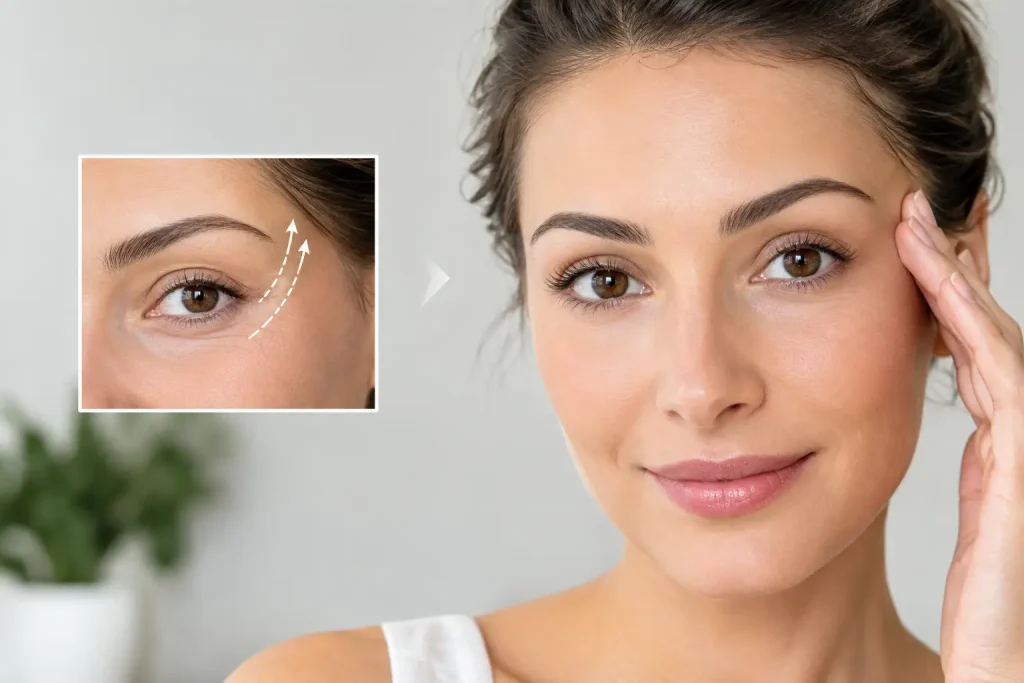
A rested, open eye appearance is rarely created by the eyelids alone. The position of the outer brow, the quality of temple support, and the balance between the forehead and upper face all influence whether the eyes appear bright or visually weighed down. So, can a temporal lift open up the eyes? For the right patient, yes. By elevating the outer brow and smoothing descent at the temples, a temporal lift can create a more refreshed eye frame without directly operating on the eyelids.
The key is precision. A well-planned temporal lift should not produce a surprised expression or an exaggerated “cat-eye” effect. It should restore a more youthful relationship between the brow, temple, and upper eyelid, while preserving the character that makes a face recognizable.
Can a Temporal Lift Open Up the Eyes?
A temporal lift, sometimes called a lateral brow lift or temporal brow lift, focuses on the outer third of the eyebrow and the tissues of the temple. With time, the lateral brow may descend, causing the upper eyelid skin to appear heavier at its outer corner. This can make the eyes look tired, narrower, or less defined, even when the eyelids themselves have not changed significantly.
Repositioning this area can gently elevate the lateral brow and reduce the visual pressure on the upper eyelid. The result may be eyes that appear more open, rested, and balanced. The lift does not enlarge the eye itself. Rather, it changes the architecture around the eye, allowing its natural shape to be seen more clearly.
This distinction matters when planning facial rejuvenation. A patient who believes they need upper eyelid surgery may, in some cases, benefit more from support at the brow and temple. In others, eyelid skin removal, eyelid fat repositioning, or a combined approach may be more appropriate. The best decision begins with an anatomical assessment rather than a one-procedure answer.
Why the Temple Area Changes the Eye Expression
The eyebrow is not a straight line. Its inner portion, arch, and tail each contribute differently to facial expression. When the brow tail falls, the outer upper eyelid can look crowded. Makeup may crease unevenly, eyeliner may disappear under the lid, and photographs can reveal an expression of fatigue that does not reflect how the patient feels.
The temple is equally important because it provides structural continuity between the forehead, brow, cheekbone, and hairline. Volume loss in this region can create hollowness, while tissue laxity can weaken the elegant upward sweep from the eye toward the hairline. A temporal lift addresses tissue position. Depending on the individual, it may be considered alongside temple volume restoration or other facial rejuvenation treatments, but these approaches serve different purposes.
An artistic facial analysis looks beyond isolated lines. The aim is not simply to raise the brow, but to create proportion. A refined result respects the patient’s bone structure, brow density, orbital shape, hairline, and gender-specific aesthetic goals.
Who May Be a Good Candidate?
Patients often consider a temporal lift when they notice heaviness concentrated at the outer upper eyelid, a lowered brow tail, mild temple laxity, or a loss of definition in the upper face. Many are in their late 30s through 50s, although candidacy is based on anatomy and skin quality rather than age alone.
A suitable candidate generally has realistic expectations and understands that a temporal lift is designed for subtle lateral rejuvenation. It is not intended to correct severe forehead laxity, deeply etched forehead lines, pronounced excess eyelid skin, or major asymmetry on its own. Patients with more extensive brow descent may require a different brow lift technique, while those with significant eyelid excess may benefit from upper blepharoplasty.
During consultation, the surgeon evaluates brow position at rest, facial animation, eyelid skin redundancy, orbital fat, temple contour, and scalp or hairline characteristics. This examination is particularly important for patients with naturally low brows or strong forehead muscles, because compensatory muscle activity can disguise the true source of upper-face heaviness.
Temporal Lift Versus Upper Eyelid Surgery
A temporal lift and upper blepharoplasty are often discussed together because both can improve the appearance of the upper eye area. However, they treat different anatomical concerns.
Upper blepharoplasty removes or repositions excess skin and, when appropriate, fat from the upper eyelid. It is often effective when the eyelid itself has true skin redundancy. A temporal lift elevates the brow tail and surrounding tissues, improving the relationship between the brow and eyelid.
Sometimes one procedure is enough. Sometimes combining them produces a more harmonious result. Removing too much eyelid skin without addressing a descended brow can create an over-operated appearance or reduce natural closure comfort. Conversely, lifting the brow without treating meaningful eyelid excess may leave a patient under-corrected. The refinement lies in identifying what is actually causing the heaviness.
How a Temporal Lift Is Performed
Temporal lift techniques vary according to the patient’s anatomy and the surgeon’s preferred approach. Incisions are typically placed within the hair-bearing scalp near the temples, where they can be designed to remain discreet. Through these access points, the surgeon carefully releases and repositions selected tissue layers to elevate the lateral brow and temple region.
The degree of elevation is deliberately measured. A few millimeters can change eye expression dramatically, which is why an aggressive lift is rarely the goal. The most elegant results tend to look as though the patient has slept well, recovered from stress, and regained definition – not as though their facial expression has been redesigned.
At a specialist practice such as Assoc. Prof. Dr. Güncel Öztürk’s, facial planning is approached as both technical and visual analysis. Surgical decisions should consider how the brow appears in motion, how the eye area relates to the cheek and temple, and how the result will mature over time.
Recovery and What to Expect
Recovery after a temporal lift varies with the technique used and whether it is performed alone or combined with other facial procedures. Swelling, bruising, a feeling of tightness, and temporary scalp sensitivity can occur in the early phase. Most visible swelling improves steadily over the following weeks, although tissues continue to settle gradually.
Patients are usually advised to sleep with the head elevated initially, avoid strenuous activity for the period recommended by their surgeon, and protect incision areas as they heal. Temporary asymmetry during early recovery is common because swelling rarely resolves at the same pace on both sides.
The final appearance should be judged patiently. A temporal lift is not a procedure to assess in the first few days or even the first several weeks. As swelling fades and the tissues adapt, the outer brow and eye area become more naturally integrated with the rest of the face.
Risks and the Importance of Individualized Planning
Like every surgical procedure, a temporal lift involves potential risks. These can include bleeding, infection, scar visibility, sensory changes, hair loss around an incision, asymmetry, prolonged swelling, or dissatisfaction with the degree of elevation. There is also the aesthetic risk of placing the brow too high or altering its shape in a way that feels unfamiliar.
Thoughtful planning reduces avoidable risk, but no surgeon can promise a perfectly identical result on both sides of the face. Natural facial asymmetry exists in nearly every patient. The objective is improvement, balance, and an outcome that remains credible in close conversation as well as in photographs.
Patients should be particularly cautious of trend-driven requests for sharply angled brows. A fashion image may be compelling for a moment, but facial surgery should be designed around enduring proportion. The most successful lift is one that supports the eyes without becoming the first thing people notice.
A More Open Look, Designed Around You
When the outer brow has descended and the temples have lost support, a temporal lift can make the eyes appear more open and refreshed. But its value is not simply elevation. It is the restoration of a graceful upper-face frame that suits the individual’s features, expression, and aesthetic identity.
The right question is not only whether the eyes can be opened up, but how much change will look natural on your face. A detailed consultation with an experienced facial aesthetic surgeon can turn that question into a plan shaped by anatomy, restraint, and long-term refinement.