


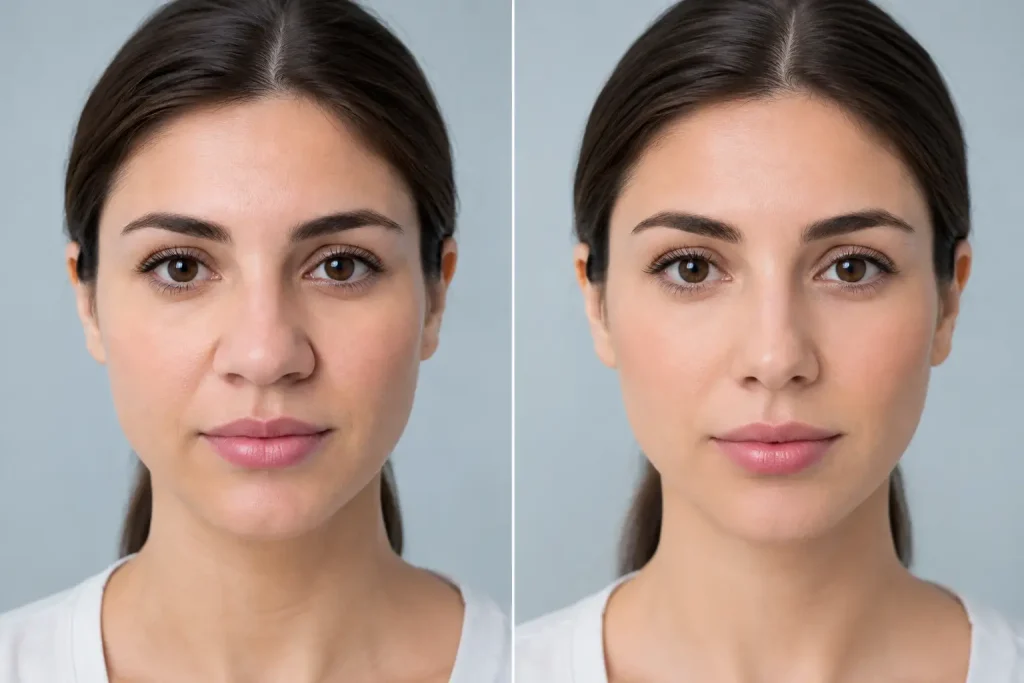
A wide nasal base can make the nose appear broader than it truly is, even when the bridge and tip are well proportioned. For patients considering refinement, the central question is often: can rhinoplasty improve a wide nasal base? In many cases, yes. The key is not simply making the nostrils smaller, but designing a base that supports the face, preserves breathing, and looks convincingly natural from every angle.
The lower third of the nose has a powerful effect on facial harmony. Its width influences the relationship between the eyes, lips, cheeks, and chin. A successful rhinoplasty therefore treats the nasal base as part of a complete facial composition, rather than an isolated measurement.
Can Rhinoplasty Improve a Wide Nasal Base Without Looking Overdone?
Rhinoplasty can improve a wide nasal base through carefully selected structural and soft-tissue techniques. Depending on the anatomy, a surgeon may refine the nostril width, reduce excessive flare, reposition the alar tissues, improve tip support, or narrow a broad bony foundation. The most appropriate method depends on why the base appears wide in the first place.
For some patients, the concern is true alar flare: the nostril rims extend noticeably beyond the natural boundaries of the face. For others, the nostrils are not especially flared, but a round tip, thick skin, a low bridge, or a broad upper jaw creates the impression of width. These distinctions matter. Narrowing the nostrils alone when the real issue is poor tip definition can produce an artificial result and may not resolve the concern.
Refinement should be measured against the rest of the face. A nose that is too narrow for the eyes, cheekbones, or lips can draw more attention rather than less. The most elegant results retain ethnic character, facial identity, and the soft transitions that make a nose look unoperated.
What Creates the Appearance of a Wide Nasal Base?
The nasal base is the area where the nostrils meet the cheeks, including the alae, or nasal wings, the columella between the nostrils, and the lower support of the tip. Its appearance is shaped by skin quality, cartilage structure, facial proportions, and the way light falls across the nose.
A wide base may be congenital, inherited as part of a family or ethnic facial pattern, or become more visually prominent after previous nasal surgery. In revision rhinoplasty, altered support, scar tissue, or excessive prior reduction can make the nostrils appear disproportionately broad. Some patients also notice a change after an injury, particularly if the bridge has widened or the tip support has weakened.
An experienced evaluation considers the nose in frontal, three-quarter, profile, and basal views. The frontal photograph may reveal flared nostrils, while the basal view can show asymmetry, an unusually broad columella, or nostrils that are shaped differently from one another. What looks like a simple width concern in the mirror may involve several anatomical details.
The Role of Facial Proportion
There is no single ideal nasal-base measurement that suits every face. Classical aesthetic guidelines can provide reference points, but they are not a prescription. A refined result should belong to the patient’s facial structure, age, gender expression, and cultural identity.
This is where artistic judgment becomes as relevant as surgical technique. The goal is not to create the smallest possible nose. It is to create balance: a nasal base that feels lighter, more defined, and more harmonious while preserving the strength and character of the face.
Techniques Used to Refine a Wide Nasal Base
When nostril flare or excessive base width is clearly present, alar base reduction, often called alarplasty, may be considered. This technique removes a very small, precisely planned amount of tissue at the nostril-cheek junction, within the nostril floor, or through a tailored combination of both. The incision placement is selected to make the resulting scar as discreet as possible.
Alar base reduction is not automatically part of every rhinoplasty. It is generally performed only when it will improve the final composition. In some cases, refining and supporting the tip creates enough visual narrowing that direct nostril reduction is unnecessary. In others, narrowing the bridge without addressing pronounced alar flare can make the base look relatively wider, which is why the entire nose must be planned as one design.
Structural tip rhinoplasty may also help. Cartilage shaping, suturing techniques, and carefully placed cartilage grafts can improve projection and definition, giving a round or poorly supported tip a more refined contour. If a broad bridge contributes to the concern, controlled bone reshaping may bring the upper and lower parts of the nose into better proportion.
For patients with thick skin, the approach requires particular restraint. Thick skin can soften visible definition and may take longer to contract around the newly shaped framework. Aggressive narrowing does not guarantee a sharper appearance and can compromise the nasal airway or produce irregular healing. A well-supported structure and realistic plan are more valuable than excessive reduction.
Breathing Must Be Part of the Design
A beautiful nasal base should never come at the expense of function. The alar region contributes to the external nasal valve, a critical part of the breathing pathway. Over-resection or poorly planned nostril narrowing can create pinching, visible notching, scar-related distortion, or obstruction during exercise and sleep.
For that reason, evaluation should include questions about prior trauma, allergies, congestion, snoring, and difficulty breathing through either side of the nose. If internal valve narrowing, septal deviation, or weak sidewalls are present, functional corrections may need to be incorporated into the rhinoplasty plan.
At a premium rhinoplasty practice, advanced imaging and three-dimensional planning can help translate aesthetic goals into a discussion grounded in anatomy. Simulation is valuable for communication, but it is not a promise or a substitute for surgical judgment. Skin behavior, healing response, and the limitations of the existing framework all influence the final result.
Healing After Nasal Base Refinement
The early postoperative period can be misleading. Swelling around the tip and nostrils may temporarily make the base look broader, uneven, or firmer than expected. This is particularly common after alar base work and in patients with thicker skin.
External swelling usually improves substantially within the first several weeks, while finer changes continue for months. The tip and base often take the longest to settle because their soft tissue envelope is dense and responsive to scar maturation. It can take up to a year, and occasionally longer in complex or revision cases, for the final refinement to become fully apparent.
Incision care, sun protection, and follow-up appointments are part of protecting the outcome. Patients should also avoid judging symmetry too early. Minor differences in swelling between the right and left sides are common during recovery and do not necessarily reflect the final shape.
Who Is a Good Candidate?
A strong candidate is someone bothered by a base that appears disproportionately wide, flared, asymmetric, or poorly integrated with the rest of the nose. They should be in good general health, have realistic expectations, and understand that sophisticated rhinoplasty favors proportion over dramatic reduction.
The best surgical plan differs for a first-time patient seeking subtle refinement and a revision patient with scarring or prior loss of support. Revision cases can require cartilage grafting, more conservative tissue removal, and a longer healing timeline. Patients who have a history of poorly healed scars, smoking, or certain medical conditions may also need a more individualized risk assessment.
A consultation should go beyond a request for “smaller nostrils.” It should examine front-view balance, smile dynamics, skin thickness, nasal airflow, and how much change the existing tissues can safely support. Assoc. Prof. Dr. Güncel Öztürk approaches nasal surgery through this union of anatomical precision and aesthetic composition, with each plan designed around the patient rather than a fixed template.
The most satisfying change is often one that is difficult for others to identify but easy for the patient to feel: a nose that appears more refined, more balanced, and wholly their own.