
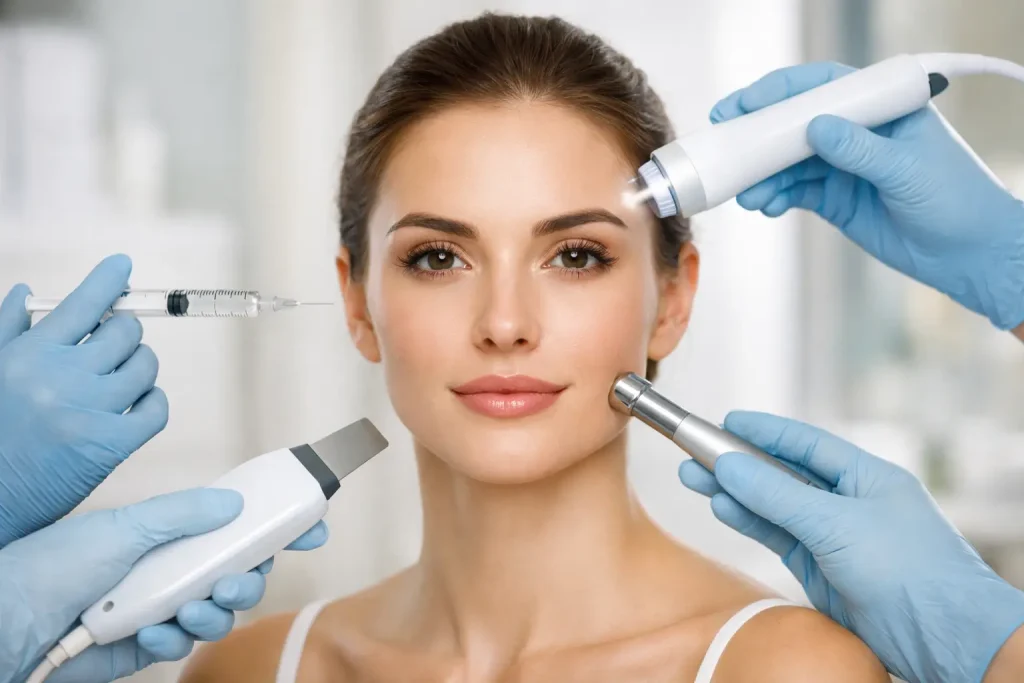
A face rarely ages in one layer. The skin loses elasticity, fat compartments shift, the jawline softens, the neck begins to show laxity, and fine lines settle in areas that makeup or skincare can no longer fully disguise. That is why combined facial rejuvenation procedures have become a more sophisticated approach for patients who want refinement rather than a piecemeal fix. Instead of treating a single wrinkle or one isolated area, combination facial rejuvenation is designed as a coordinated plan – one that respects facial anatomy, proportion, and expression.
For discerning patients, the appeal is not simply to look younger. It is to look rested, elegant, and structurally harmonious without the telltale signs of overtreatment. This is where experience matters. A refined result depends on seeing the face as a whole composition, not as separate problems to be chased one by one.
What combined facial rejuvenation procedures really mean
Combination facial rejuvenation refers to the strategic use of two or more treatments in the same plan to address different layers of facial aging. That may include surgery, injectables, energy-based treatments, skin resurfacing, or regenerative methods. The exact combination depends on age, skin quality, facial structure, downtime tolerance, and the level of correction a patient wants.
A patient in their late 30s may need volume support, subtle skin tightening, and texture correction. A patient in their 50s or 60s may benefit more from a surgical lift combined with eyelid surgery, fat grafting, and resurfacing. The principle is the same in both cases: a stronger result often comes from treating structure, volume, and skin quality together.
This matters because a single treatment can improve one dimension while leaving others untouched. Fillers can restore volume, but they do not reposition descended tissues. A facelift can improve laxity, but it does not erase sun damage or pigment irregularity. Laser treatments can refine the skin surface, but they do not recreate youthful contours on their own.
Why a combined approach often looks more natural
Paradoxically, doing more can look less obvious – if the plan is designed well. When the entire face is assessed as a balanced aesthetic unit, each intervention can be more conservative. Instead of overfilling the midface or overtightening the skin to compensate for untreated issues, the surgeon distributes correction across the appropriate layers.
This is one of the most important distinctions between high-level facial rejuvenation and volume-driven cosmetic treatment. Natural beauty is rarely created by exaggerating a single feature. It is usually restored by reestablishing proportion, light reflection, contour transitions, and clean anatomical definition.
A refreshed face tends to show several subtle qualities at once: a more defined jawline, smoother lid-cheek transition, improved neck contour, better skin texture, and softer facial shadows. None of these improvements needs to be extreme. Together, they create the impression patients are usually seeking.
Which procedures are commonly combined
The most effective combined facial rejuvenation procedures vary by patient, but certain pairings are especially common because they address complementary concerns.
Facelift and neck lift
When facial aging involves jowling, lower-face heaviness, and neck laxity, these two procedures are often treated together. Addressing only the face can leave the neck behind, while treating only the neck may fail to restore definition around the jawline. Performed together, they create continuity from cheek to chin to neck.
Eyelid surgery and brow refinement
The eyes communicate fatigue earlier than most other features. Upper eyelid skin excess, lower eyelid puffiness, and brow descent can all contribute to a tired appearance. In some patients, upper and lower blepharoplasty combined with brow support creates a much more elegant result than treating only one area.
Fat grafting and lifting procedures
Lifting restores position. Fat grafting restores softness and youthful fullness. This distinction is critical. Patients who have lost volume in the temples, under-eye area, cheeks, or around the mouth may look improved after a lift, but still somewhat skeletal if volume is not addressed. Carefully placed fat transfer can add vitality without the repetitive maintenance associated with some nonsurgical options.
Laser resurfacing, RF, or chemical peeling
Even a beautifully repositioned face can still show textural age if the skin surface remains damaged by sun exposure, enlarged pores, or fine wrinkling. Skin treatments help refine the canvas. The right modality depends on skin type, recovery expectations, and whether pigment, texture, or laxity is the dominant issue.
Injectables and regenerative treatments
Not every combination plan is surgical. In earlier stages of aging, neuromodulators, fillers, collagen-stimulating injectables, PRP, or other regenerative approaches may be combined to preserve facial freshness without surgery. These plans require restraint. More product is not the same as better design.
Surgical and nonsurgical combinations are not interchangeable
One of the biggest misconceptions in facial aesthetics is that multiple nonsurgical treatments can always replace surgery. They cannot. They can postpone surgery in selected patients, and they can maintain surgical results beautifully, but they do not have the same mechanical power when tissues have significantly descended.
This is where honest consultation becomes essential. A patient with pronounced jowling, neck bands, and deep tissue descent may be disappointed by a purely injectable strategy, no matter how advanced the products are. On the other hand, a younger patient with early volume loss and mild skin laxity may not need an operation at all.
The best plan is not the most aggressive one. It is the one that matches anatomy and goals with precision.
How treatment planning should be done
A premium facial rejuvenation plan begins with analysis, not with a menu. The face should be evaluated in motion and at rest, from frontal and profile views, under different lighting conditions, and in the context of the patient’s age, style, and aesthetic identity.
Strong planning considers skeletal support, fat distribution, skin density, brow position, eyelid shape, lip balance, and the relationship between the face and neck. It also considers what the patient does not want. Some patients welcome a transformative reset with downtime. Others want an understated evolution that friends notice without being able to identify why.
In advanced aesthetic practice, artistry is not a decorative extra. It is the discipline of knowing how much correction is enough, where to stop, and how to preserve individuality. This philosophy is especially relevant in facial rejuvenation, where overcorrection can flatten character and create a generic appearance.
Recovery and timing require strategy
Combined procedures can be efficient, but they also require smart timing. When appropriate treatments are performed together, patients often benefit from one anesthesia event, one recovery period, and a more unified result. That can be appealing for international patients or busy professionals who want to minimize disruption.
Still, not everything should be done at once in every case. Skin resurfacing may be staged. Some injectables may be better used after surgical healing. Patients with thinner skin, slower healing patterns, or specific medical considerations may need a phased plan for safety and better tissue response.
This is another reason experience matters. Combination treatment is not just about stacking procedures. It is about sequencing them intelligently.
Who is a good candidate for combined facial rejuvenation procedures
The ideal candidate is not defined by age alone. More important factors include visible signs of aging in multiple layers, realistic expectations, good overall health, and a preference for tailored outcomes over trend-driven treatments.
Patients who often benefit most are those who say things like, “I look tired even when I feel well,” “My face looks heavier but also more hollow,” or “I want improvement, but I do not want to look altered.” These concerns usually point to layered aging – and layered aging responds best to a layered solution.
Patients should also understand that longevity varies. A facelift may last years, while skin quality treatments and injectables usually require maintenance. Combination planning often delivers the most complete result, but not every component has the same timeline.
Choosing refinement over excess
The market is full of quick fixes, aggressive trends, and standardized packages. Facial rejuvenation deserves a more disciplined approach. The face is where surgical judgment, anatomical knowledge, and aesthetic restraint are tested most visibly.
In a high-level practice, combined facial rejuvenation procedures are not assembled casually. They are composed. Each procedure should have a clear role in the final design, whether that role is lifting, restoring volume, refining texture, or preserving expression. This is the difference between a face that looks “done” and one that simply looks exceptionally well.
For patients considering treatment in Istanbul or comparing premium surgeons internationally, this distinction is central. At the highest standard, facial rejuvenation is not about chasing youth at any cost. It is about restoring clarity, elegance, and confidence with methods that respect both anatomy and identity.
The right plan should make you look more like yourself – just with less fatigue, less heaviness, and more light in the face.