

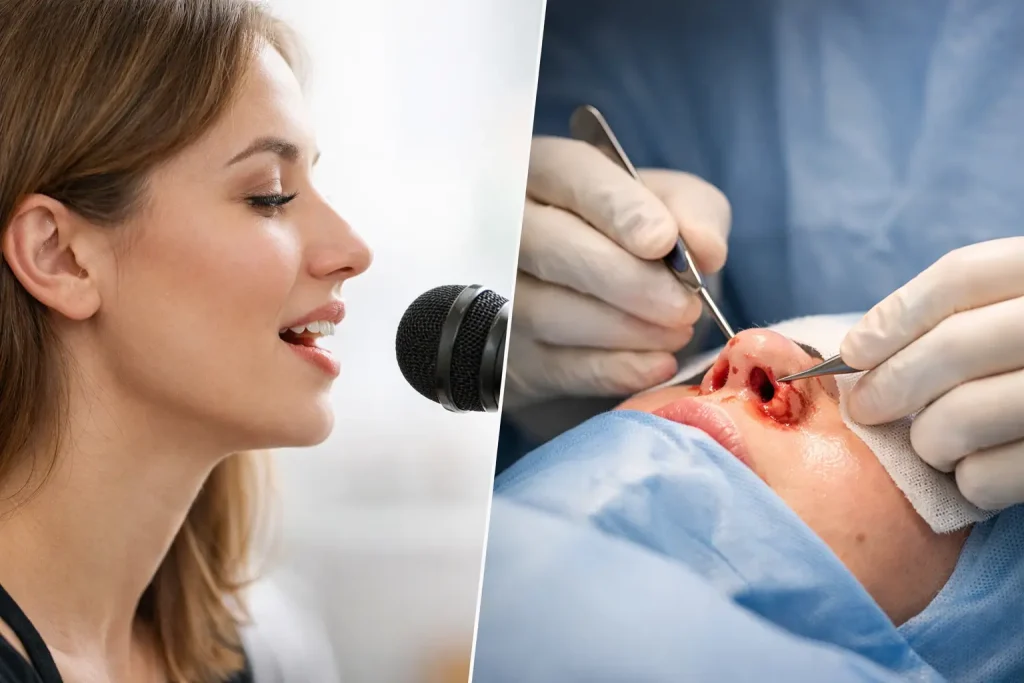
A refined nose should never come at the expense of a natural voice, so it is understandable that many patients ask, Does Voice Change After Nose Surgery? The short answer is sometimes, but usually only temporarily. After rhinoplasty, some people notice that their voice sounds more nasal, slightly congested, or less familiar for a period of time. In most cases, this is related to swelling, internal dressings, mucus, and the normal healing process rather than a permanent alteration of the voice itself.
Does Voice Change After Nose Surgery?
The voice is shaped by more than the vocal cords. It is also filtered through the throat, mouth, sinuses, and nasal passages. Because the nose plays a role in resonance, any surgery that changes airflow inside the nose can briefly affect how the voice is perceived.
That distinction matters. Rhinoplasty does not operate on the vocal cords, so it does not directly change the source of your voice. What can change is resonance – the way sound travels and is amplified through the upper airway. If the nose is swollen or partially blocked after surgery, the voice may sound denasalized, stuffy, or muted. Once healing progresses and airflow stabilizes, the voice often returns to its familiar character.
For a small subset of patients, especially those whose profession depends on subtle vocal control, even temporary changes can feel significant. Singers, actors, broadcasters, teachers, and public speakers tend to notice shifts that others might not. In these cases, preoperative planning should take both aesthetics and airway dynamics into account.
Why the voice may sound different after rhinoplasty
Immediately after surgery, the inside of the nose is not functioning as it normally does. The tissues are swollen, secretions increase, and breathing through the nose may be limited. Even patients with beautifully executed structural work can sound congested in the early phase. This is expected.
The most common reason for a voice change is reduced nasal airflow. Certain speech sounds rely on air passing through the nose. When that pathway is narrowed by postoperative swelling, those sounds may shift. Patients often describe this as sounding like they have a cold.
Another factor is internal support. Depending on the surgical technique, splints or dressings may be placed inside the nose. These are useful for healing, but they temporarily alter the internal space where resonance occurs. Once they are removed and swelling subsides, speech usually feels more natural.
There is also a less obvious scenario. Some patients had long-standing nasal obstruction before surgery and did not fully realize how much it affected their voice. After corrective functional work, they may hear their voice as brighter, clearer, or less hyponasal. This can feel unfamiliar at first, even when it represents improved airflow rather than a problem.
Temporary changes versus lasting changes
For most patients, voice changes after rhinoplasty are temporary. The first one to three weeks are the most noticeable because swelling and congestion are at their peak. Over the following weeks, the nasal passages gradually open and the voice settles.
More refined healing takes longer. Internal tissues can continue to mature for months, particularly in patients with thicker skin, revision surgery, or extensive structural correction. That does not mean the voice remains altered the entire time, but subtle shifts in resonance may normalize gradually rather than overnight.
Permanent voice changes are uncommon after well-planned rhinoplasty. When they do occur, they are more likely to be related to significant changes in nasal airflow, preexisting anatomical issues, scar formation, or surgery that did not adequately preserve the functional architecture of the nose. This is one reason surgeon selection matters so much. Rhinoplasty is not simply about reducing or reshaping the nose from the outside. It requires a sophisticated understanding of breathing, support, balance, and the acoustic role of the nasal cavity.
Who is more likely to notice a change?
Not every patient will perceive the same thing. A person who works at a desk and speaks casually throughout the day may barely notice a temporary shift. A professional vocalist may detect a very fine change in resonance within days.
Patients with prior breathing difficulty are also more sensitive. If you already struggle with a deviated septum, valve collapse, turbinate enlargement, allergies, or chronic sinus issues, postoperative swelling can feel more dramatic. In these cases, healing may include a transition period where airflow feels inconsistent before it improves.
Those undergoing combined cosmetic and functional rhinoplasty should discuss voice concerns clearly before surgery. That conversation helps define priorities. In elite rhinoplasty practice, the goal is not only a more elegant nasal form but a stable, well-supported airway that respects the patient’s daily life, profession, and self-image.
Can nose surgery improve the way the voice sounds?
In some cases, yes. If a patient had severe obstruction before surgery, correcting the internal anatomy may improve nasal airflow and therefore change resonance in a positive way. Speech may sound less blocked, and breathing during speaking may feel easier.
This does not mean rhinoplasty is a voice procedure. It is not designed to enhance tone quality in the way vocal training does. Still, restoring balance to the nasal airway can influence how sound moves through the face. For some patients, that creates a cleaner, more open quality.
The key point is nuance. A voice that sounds different is not automatically a worse voice. It may simply be a voice adjusting to a new airway. Context matters, and expectations should be individualized.
What to expect during recovery
In the first few days after surgery, your voice may sound congested because your nose is congested. That is the most predictable phase. You may also breathe more through your mouth, which can make speaking feel dry or slightly strained.
After splints or internal dressings are removed, many patients notice immediate improvement, but not always complete normalization. Residual swelling inside the nose can persist beyond what is visible on the outside. This is why a nose may look socially presentable while still feeling internally stiff or blocked.
By the first month, most temporary speech changes have improved substantially. More delicate internal settling continues after that. If your work depends on vocal performance, it is wise to schedule surgery with an appropriate recovery window rather than assuming you will sound identical within a few days.
When to talk to your surgeon
A temporary change in resonance is usually not a cause for concern. Still, if your voice feels persistently unusual or breathing remains difficult beyond the expected healing period, your surgeon should evaluate you.
Persistent symptoms may include chronic nasal blockage on one or both sides, worsening rather than improving resonance, whistling airflow, significant dryness, or a feeling that speech effort has increased. These do not automatically indicate a major issue, but they deserve professional assessment.
A thoughtful rhinoplasty consultation should always include a review of your breathing history, prior trauma, allergies, previous nasal surgery, and whether your career places special demands on the voice. At a premium level of care, these details are not secondary. They are part of the design process.
How surgical planning helps protect natural voice quality
The most elegant rhinoplasty is one that respects both beauty and function. Over-resection, poor support, or inadequate attention to the internal nasal valve can create problems that go beyond appearance. A sophisticated approach preserves structure, controls airflow, and avoids changes that compromise daily comfort.
This is where surgeon judgment becomes decisive. Advanced rhinoplasty is an architectural procedure. Every adjustment to cartilage, septum, and internal passageways influences not only shape but performance. In high-level practice, especially in design-driven rhinoplasty, aesthetic refinement and airway preservation are treated as inseparable.
For patients who are highly voice-aware, that philosophy matters. The right plan accounts for facial harmony, breathing quality, tissue behavior, and long-term stability rather than chasing a fashionable nose shape without regard for function. Clinics such as DRGO Clinic emphasize that balance because the most successful result is not merely seen – it is lived with ease.
A more useful question than whether the voice changes
Rather than asking only whether the voice changes, ask what kind of change is expected, how long it may last, and how your surgeon protects nasal function. That is the conversation that separates routine cosmetic surgery from truly individualized rhinoplasty.
If your voice is central to your profession or identity, say so early. A skilled surgeon will not dismiss that concern as minor. The nose sits at the intersection of form, airflow, and resonance, and each of those deserves precise attention.
A beautiful result should feel as natural in conversation as it looks in the mirror.