

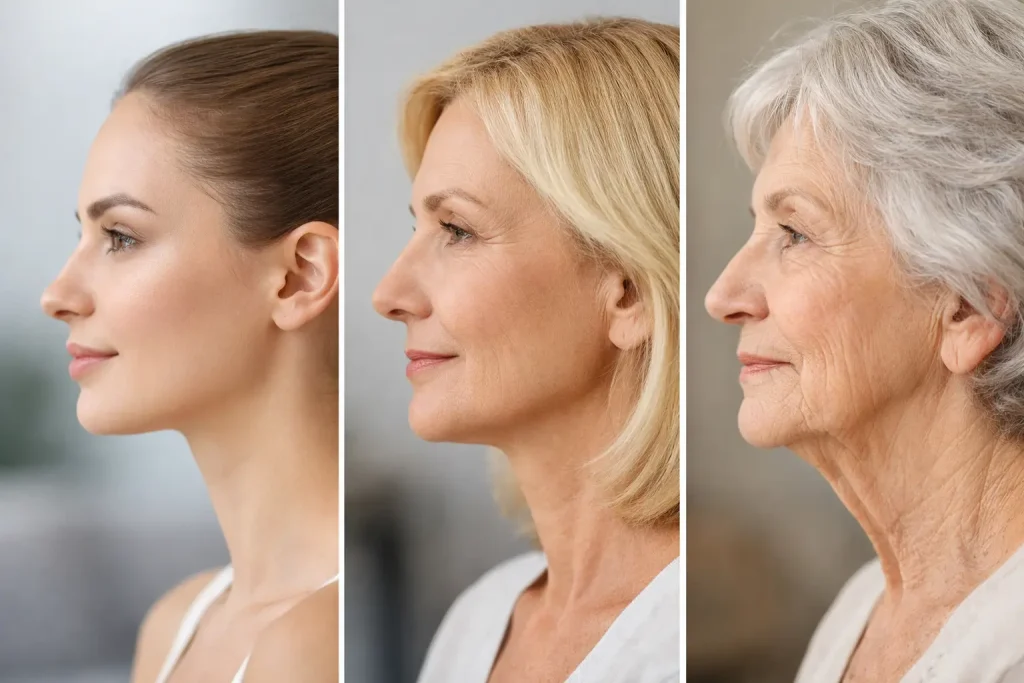
A nose does not age in isolation. It ages with the skin, the cartilage, the ligaments, and the rest of the face. That is why one of the most thoughtful questions a patient can ask is not simply whether rhinoplasty looks good at six months, but what happens to rhinoplasty as people age.
The answer is reassuring, but not simplistic. A well-executed rhinoplasty is designed to mature with the face, not fight against it. At the same time, no surgical result is frozen in time. Decades after surgery, the nose will still respond to gravity, changes in skin quality, facial volume loss, and the natural softening of supporting tissues. The quality of the original operation matters enormously here. So do anatomy, age at surgery, and the techniques used to preserve or reinforce structure.
What happens to rhinoplasty as people age?
In most cases, rhinoplasty ages quite well when the nose has been shaped with respect for anatomy and support. The refined result does not suddenly disappear. What changes is the surrounding framework and the tissue envelope over it.
Skin gradually loses elasticity and collagen. The facial skeleton and soft tissue compartments change subtly with time. Cartilage can weaken, and the tip may lose some of its youthful definition if support was not carefully preserved during surgery. Patients who had overly aggressive reduction techniques many years ago are often the ones who notice age-related distortion most clearly. Their noses may begin to look pinched, droopy, asymmetrical, or less functional over time.
By contrast, modern rhinoplasty philosophy favors preservation, balance, and structural integrity. That approach tends to produce results that remain elegant for years because the nose has not been weakened in pursuit of a short-term visual effect.
Why the nose changes even after a successful operation
A refined nose is still living tissue. That distinction matters. Rhinoplasty reshapes the nose, but it does not stop the biological processes of aging.
Over time, the nasal tip can descend slightly as ligaments and cartilage support soften. This does not necessarily mean something has gone wrong. A small degree of change is part of normal maturation. The bridge may also appear different over the years, not only because the nose changes, but because the cheeks, lips, and chin evolve too. Facial aging changes proportion, and proportion is central to how the nose is perceived.
Skin thickness also plays a role. Thin skin may reveal tiny irregularities more readily with age, especially if the underlying structure was not smooth and stable. Thick skin, on the other hand, can become heavier and may soften tip definition over time. Neither skin type is inherently problematic, but each requires a different surgical strategy.
This is why experienced rhinoplasty surgeons think beyond immediate refinement. They design for longevity.
The biggest factor is how the first rhinoplasty was performed
When patients ask what happens to rhinoplasty as people age, the most honest answer often begins with technique. Not all rhinoplasties age the same way.
Older reduction methods sometimes removed too much cartilage and bone to create a smaller nose. That could look attractive early on, especially in younger faces with firmer skin and stronger tissue support. Years later, however, that same nose might begin to collapse inward, rotate downward, or show breathing problems. A nose that was over-resected can age poorly because it was left without enough internal architecture.
A structurally sound rhinoplasty is different. It respects the nose as both an aesthetic form and a functional airway. Support grafts, preservation concepts, tip stabilization, and precise planning all help maintain shape over time. This is where advanced rhinoplasty becomes less about reduction and more about sculptural engineering.
For that reason, revision rhinoplasty is often sought many years after a first operation. The issue is not always that the original result looked poor from the beginning. Sometimes it simply did not have the strength to age gracefully.
Does age at the time of surgery matter?
Yes, but not in a simplistic way. A patient who has rhinoplasty in their twenties will naturally live with that result through more decades of facial aging than someone who has surgery at forty-five. That does not make early surgery a poor choice. It simply means the result will continue to evolve with the face over a longer period.
Younger skin often contracts well and may display definition beautifully after surgery. As the years pass, however, facial contours change, and the nose may read differently within the whole aesthetic composition. Patients who have surgery later in life may be operating on skin with less elasticity, but their long-term facial framework is often more stable in the sense that major youthful changes have already occurred.
The right timing depends on anatomy, goals, emotional readiness, and surgical planning, not just a number.
Common long-term changes patients may notice
Many patients notice very little beyond natural softening. Others become more aware of the nose because the rest of the face ages around it.
A slight drop in the tip is one of the most common age-related changes. Mild asymmetries can also become more visible over time, particularly in noses that already had asymmetrical cartilage or deviated structure before surgery. In some cases, breathing may change if the internal valves were weak to begin with or if structural support was reduced too aggressively.
There is also a visual phenomenon that is worth understanding. A rhinoplasty can remain technically stable, yet seem different because volume loss in the midface, changes around the mouth, or skin laxity alter facial balance. Patients sometimes interpret this as the nose changing dramatically, when in reality the face-nose relationship has changed.
That is why mature facial aesthetics should always be assessed as a whole composition rather than a single feature.
Can rhinoplasty make someone look older later on?
It can, if the result was overdone. An excessively narrow bridge, a sharply pinched tip, or an unnaturally rotated profile may look less harmonious as the face matures. Precision without softness can age poorly. The most enduring rhinoplasty results are rarely the ones that look most aggressively altered.
Naturalism tends to have a longer aesthetic life. A nose that suits the patient’s ethnicity, skin quality, facial proportions, and character usually continues to look sophisticated over time because it does not rely on trend-driven features. This is especially important for patients seeking premium, image-conscious outcomes. Refinement should elevate the face, not detach from it.
When aging changes become a reason for revision
Not every age-related change needs treatment. Some are subtle and entirely normal. Revision becomes relevant when there is a structural, functional, or aesthetic issue that meaningfully affects confidence or breathing.
A tip that has dropped significantly, visible irregularities, collapse during inhalation, or a nose that now feels disconnected from the face may justify reassessment. In mature patients, revision planning is often more nuanced than in younger ones because skin quality, scar tissue, and support deficits must all be considered.
This is where surgeon expertise becomes decisive. Revision rhinoplasty is not simply a second attempt at cosmetic improvement. It is a high-level reconstructive and aesthetic problem, requiring judgment, restraint, and technical fluency.
How to help a rhinoplasty age well
The best protection begins before surgery. Choosing a surgeon who values long-term structure over short-term drama is far more important than any cream, treatment, or trend that comes later.
After surgery, stable weight, good skin care, sun protection, and avoidance of trauma all help preserve the quality of the result. General wellness matters too. Smoking, poor healing habits, and repeated nasal injury can affect both appearance and tissue quality over time.
For some patients, non-surgical facial rejuvenation later in life can also improve how the rhinoplasty is perceived. If volume loss or skin laxity elsewhere in the face is making the nose appear more prominent, addressing the surrounding facial architecture may restore harmony without touching the nose itself.
At a specialist clinic such as DRGO Clinic, this kind of planning is typically approached as facial design rather than isolated procedure selection. That perspective matters when the goal is not just change, but longevity.
A more refined way to think about rhinoplasty and aging
The real question is not whether a rhinoplasty will age. It will, because every living structure does. The more meaningful question is whether it was created with enough intelligence, balance, and support to age beautifully.
The best rhinoplasty does not chase a moment. It respects time. Years later, that is often what separates a merely noticeable nose from one that still looks quietly right when the face around it has matured.