


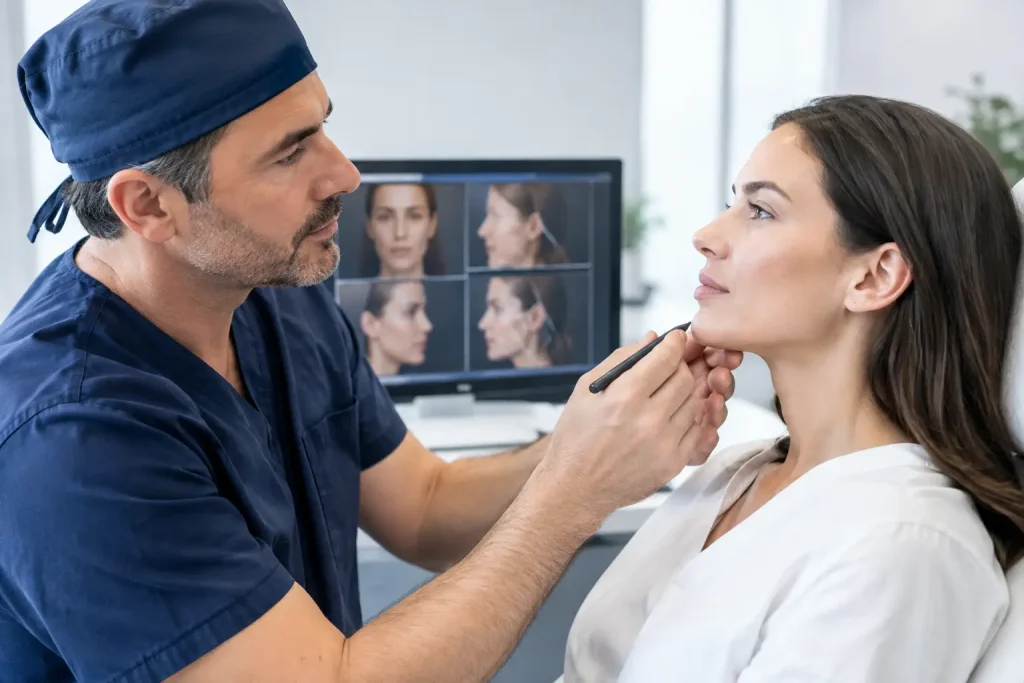
A face can be technically altered and still fail to look like it belongs to the person wearing it. That distinction is at the center of how surgeons plan for natural-looking facial results: the goal is not to impose a fashionable template, but to refine proportions while preserving the features that make a face recognizable, expressive, and personal.
For patients considering rhinoplasty, facial rejuvenation, eyelid surgery, chin enhancement, or a combined approach, naturalness is not a vague promise. It is the outcome of detailed analysis, disciplined surgical judgment, and an aesthetic plan designed around the individual rather than the procedure.
Natural-Looking Facial Results Begin With Facial Identity
A well-planned facial procedure respects the architecture already present. Facial character is shaped by the relationship between the forehead, eyes, nose, cheeks, lips, chin, jawline, skin quality, and the way each feature moves in expression. Changing one element can influence how all the others are perceived.
This is why an experienced facial surgeon does not assess a nose, eyelid, or jawline in isolation. A nose that is attractive in a simulation may look over-reduced on a strong face. A highly projected cheek may be disproportionate on a naturally delicate facial structure. A sharper jawline can be elegant for one patient and overly severe for another.
The objective is harmony, not feature-by-feature perfection. In premium aesthetic surgery, restraint is often as valuable as technical capability. The most refined result may be the one that makes others notice that a patient looks rested, balanced, or more confident without immediately identifying surgery.
How Surgeons Plan for Natural-Looking Facial Results
Planning begins with a consultation that goes beyond a list of requested changes. The surgeon studies the patient’s facial proportions from the front, profile, and three-quarter views, as well as the quality of the skin, degree of tissue laxity, skeletal support, and asymmetries. Nearly every face has natural asymmetry. The aim is usually to improve distracting imbalance, not to create artificial mathematical symmetry.
Photography is essential because facial proportions can appear different depending on angle, lighting, lens choice, and posture. Standardized images allow the surgeon to evaluate structural relationships with greater consistency. In selected cases, 3D imaging and simulation can add another layer of precision by helping patients understand projected changes in volume, contour, or nasal shape.
Simulation is a communication tool, not a guarantee. Healing, soft-tissue behavior, scar maturation, and the limits of safe surgical modification all affect the final result. A responsible surgeon uses imaging to establish a shared aesthetic direction while explaining what can realistically be achieved in an individual face.
Proportion Is More Valuable Than Trend
Social media has made certain facial ideals highly visible: a narrow nose, high cheekbones, a sharply contoured jaw, or dramatically lifted eyes. These references can be useful when they help a patient articulate what they like. They become less useful when copied without regard for anatomy, ethnicity, age, or the patient’s existing proportions.
A natural-looking plan is rooted in balance. For rhinoplasty, that may mean preserving enough nasal structure to suit the chin and forehead rather than pursuing the smallest possible nose. For facial rejuvenation, it may mean restoring carefully placed volume and repositioning descended tissues instead of stretching the skin into an unnaturally tight appearance.
Age also changes the equation. A youthful face may benefit from conservative contour refinement, while a mature face may require attention to laxity, volume loss, skin texture, and skeletal support. The same intervention can look either elegant or excessive depending on when, why, and how it is used.
Anatomy Sets the Boundaries of Good Design
Artistic vision matters in facial aesthetics, but it must be guided by anatomy. Bone structure, cartilage strength, skin thickness, muscle activity, and tissue elasticity determine what can be changed safely and what will remain stable over time.
For example, thick nasal skin may limit the definition visible after rhinoplasty, while thin skin can reveal even subtle underlying irregularities. In eyelid surgery, the position of the brow, orbital anatomy, and eyelid support influence how much skin can be removed without compromising a natural expression. In facelift planning, the surgeon must account for the deeper facial support layers, not simply tighten surface skin.
The most sophisticated plans work with these anatomical realities. They do not promise results that biology cannot sustain.
The Importance of Expression and Movement
A face is not a still photograph. It smiles, speaks, squints, frowns, and communicates before a person says a word. Planning for natural results means considering dynamic expression as carefully as static proportions.
This is particularly relevant in treatments involving the forehead, brows, eyes, lips, and lower face. Overcorrection around the eyes can make a patient appear surprised or hollow. Excessive neuromodulator use can reduce the expressive movement that gives a face warmth. Overfilling the lips or cheeks can alter the way the face moves and catches light.
A measured approach protects the patient’s recognizable expression. In many cases, the ideal endpoint is refinement that remains convincing at conversation distance, in motion, and in unedited photographs.
Surgical Planning Often Includes What Not to Do
One of the clearest signs of mature aesthetic judgment is knowing when a requested procedure is unnecessary, premature, or unlikely to deliver the desired improvement. A patient may believe the nose is the central issue when chin position is affecting the profile more significantly. Another may request a facelift when minimally invasive treatments, skin-focused care, or a more limited procedure would better match the degree of aging.
Combined procedures can be valuable when they address connected concerns efficiently, but they must be selected carefully. More surgery is not automatically better surgery. Combining rhinoplasty with chin augmentation, for instance, may create a stronger profile balance in the right patient. In another, rhinoplasty alone may be sufficient.
The same principle applies to non-surgical treatments. Fillers, regenerative applications, energy-based technologies, and skin treatments may complement surgery, postpone it, or be inappropriate depending on the concern. The treatment plan should follow the anatomy and the patient’s goals, not a predetermined menu.
A Shared Aesthetic Language Matters
Patients often use words such as “natural,” “defined,” “feminine,” “refreshed,” or “snatched,” yet these words can mean very different things to different people. A thorough consultation turns broad preferences into specific visual priorities.
The surgeon may ask what a patient likes in older photographs, which features they would never want to lose, and what concerns them most in profile or on video. Reference images can help, but they should be interpreted as examples of mood, contour, or proportion rather than instructions to replicate another person’s face.
At Assoc. Prof. Dr. Güncel Öztürk’s practice, this design-led perspective reflects the principle that facial surgery is both an exact medical discipline and a highly individual aesthetic composition. The strongest plan is one the patient understands clearly, including its limits, recovery process, and long-term considerations.
Healing Is Part of the Final Design
Natural results cannot be judged immediately after surgery. Swelling, bruising, tissue firmness, and temporary asymmetry are normal parts of recovery, especially in rhinoplasty and facial rejuvenation procedures. Some changes settle within weeks, while refined details may continue to evolve for months.
A surgeon plans with healing in mind by using techniques appropriate to tissue quality and by avoiding unnecessary trauma or overcorrection. Patients contribute by following recovery instructions, protecting incisions, attending follow-up appointments, and allowing enough time before evaluating the outcome.
There is also a difference between a result that looks dramatic early and one that ages gracefully. Structural preservation, conservative tissue handling, and proportionate changes often support a result that remains believable long after the recovery period has passed.
Choosing a Plan That Still Feels Like You
The best facial aesthetic plan should make room for individuality. It should address a genuine concern while preserving the facial traits that carry identity, heritage, and expression. That requires technical skill, advanced planning tools, and an eye trained to see the face as a whole.
Before choosing a procedure, look beyond a single before-and-after image. Ask whether the surgeon’s work appears balanced across different facial types, whether patients retain expression, and whether the proposed change makes sense for your anatomy and long-term goals. A natural-looking result is rarely accidental. It is the product of thoughtful design, precise execution, and the confidence to enhance without erasing.