



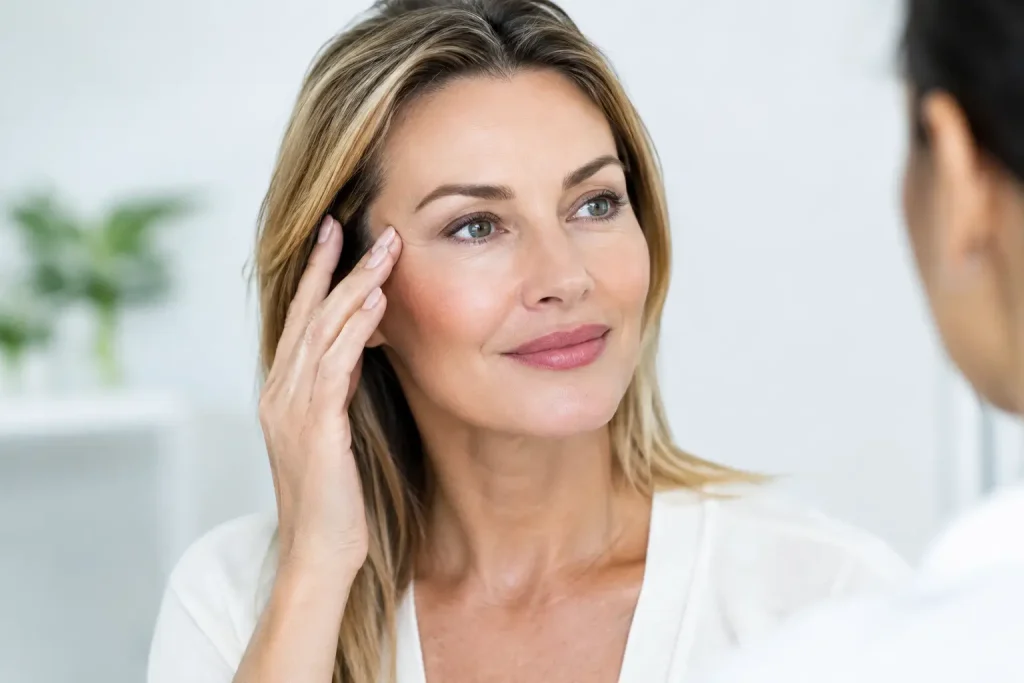
The outer eye area often reveals facial aging before the lower face does. A brow that once sat in a graceful, open position may begin to settle, creating heaviness at the temples, subtle hooding over the upper eyelids, and a tired expression that does not reflect how a person feels. For patients asking who is a good candidate for a temporal lift?, the answer is less about age alone and more about the specific architecture of the brow, forehead, eyelids, and upper face.
A temporal lift, also called a lateral brow lift or temple lift, is designed to elevate the outer portion of the eyebrow and restore a more refined frame around the eyes. It is not intended to dramatically change a patient’s expression. When thoughtfully planned, it can create a rested, elegant, and naturally more youthful appearance while preserving the individual character of the face.
What a Temporal Lift Is Designed to Improve
The temporal lift focuses on the lateral third of the brow, the area extending from the outer arch toward the temples. With time, gravity, skin laxity, repeated facial movement, and changes in facial volume can cause this area to descend. The result may be an elongated upper eyelid, a downward pull at the outer eye, or a loss of definition between the brow and eyelid.
Unlike a full forehead lift, a temporal lift is more targeted. It is especially valuable when the central brow position remains balanced but the outer brow has begun to droop. By selectively elevating this region, the procedure can improve the contour of the brow tail, soften lateral eyelid hooding, and create a more open-looking eye area.
This distinction matters. Some patients believe they need upper eyelid surgery when the concern is actually brow descent. Others request a brow lift when excess upper eyelid skin is the primary issue. An expert facial assessment separates these possibilities, because treating the wrong structure can lead to an incomplete result or an overcorrected appearance.
Who Is a Good Candidate for a Temporal Lift?
The best candidates usually have mild to moderate descent of the outer brow and want a meaningful yet controlled improvement in the upper face. They may notice that their eyes appear less open in photographs, makeup gathers beneath folds of skin at the outer eyelid, or their brow shape has gradually flattened or lowered.
A strong candidate typically has good skin quality, realistic expectations, and a preference for refined rejuvenation rather than a dramatic change in identity. Many patients are in their late 30s through 50s, although age is not the deciding factor. A younger patient may have genetically low-set or asymmetrical brows, while an older patient may require a more comprehensive approach because of greater forehead laxity or eyelid skin excess.
Candidates often share several characteristics:
- The outer brow sits lower than it once did or has a naturally low lateral position.
- The upper eyelids look heavy primarily at the outer corners.
- The patient wants the eye area to appear more rested, lifted, and balanced without altering the natural brow expression.
- The forehead and central brow are relatively well positioned, making a full brow lift unnecessary.
- The patient is medically suitable for elective surgery and can pause smoking or nicotine use as directed before and after treatment.
The visual goal should be subtle elevation, not an exaggerated arch. In premium facial aesthetics, the most convincing result is one that looks harmonious from every angle. A beautifully designed temporal lift respects brow height, orbital anatomy, gender-specific facial proportions, hairline position, and the patient’s natural facial animation.
Patients With Early Signs of Upper-Face Aging
For patients experiencing early upper-face aging, a temporal lift can be an especially elegant option. They may not need a facelift, full brow lift, or extensive eyelid surgery, but they recognize that the outer eye region has lost its former clarity.
The procedure can be particularly effective for individuals whose facial concerns are concentrated in the lateral brow and temple area. By improving this small but visually influential region, the face can appear brighter and more composed without overt signs of surgery.
Patients Seeking a More Defined Brow-Eye Relationship
A well-positioned brow creates a carefully proportioned distance between the eyebrow and upper eyelid. When the lateral brow descends, this relationship can become compressed, making the eye appear smaller or more fatigued. Candidates who want to restore this balance may benefit from a temporal lift, provided the concern comes from brow position rather than only excess eyelid skin.
This is why a consultation should include careful examination both at rest and during expression. Raising the brows unconsciously can disguise the true degree of descent. The surgeon must evaluate the face in motion to determine whether lifting the temple area will deliver the intended aesthetic benefit.
When a Temporal Lift May Not Be Enough
A temporal lift is precise by design, but precision also means respecting its limitations. It does not correct every type of upper-face concern. Patients with substantial central brow descent, deep horizontal forehead lines, or extensive skin laxity may be better served by a broader brow-lifting technique.
Likewise, pronounced excess upper eyelid skin may require upper blepharoplasty, either alone or in combination with a temporal lift. When both brow descent and eyelid laxity are present, treating only one issue may leave the patient feeling that the eye area remains heavy. A combined plan can be appropriate, but only when each procedure contributes clearly to the overall design.
A temporal lift also cannot replace a facelift for lower-face concerns such as jowling, jawline laxity, or significant neck aging. Facial rejuvenation works best when it is anatomically specific. The upper face, midface, lower face, and neck should be assessed as connected aesthetic zones, while each is treated according to its own needs.
Patients with uncontrolled medical conditions, active skin infections, significant bleeding risks, or unrealistic expectations should postpone or reconsider surgery. The same applies to anyone seeking a highly elevated, permanently surprised brow shape. A successful result should enhance expression, not compete with it.
The Importance of Facial Design and Surgical Planning
Temporal lifting is not simply about pulling tissue upward. The vector of elevation, the amount of lift, the incision placement, the quality of the skin, and the relationship to the hairline all influence the final result. An overly vertical lift can look unnatural. An insufficient lift may not adequately improve lateral hooding. A refined approach uses anatomical understanding and artistic judgment to find the degree of correction that suits the individual face.
At Assoc. Prof. Dr. Güncel Öztürk’s practice, facial procedures are approached through the balance of surgical precision and aesthetic design. The aim is not to apply a standard template, but to assess how the brow contributes to the patient’s overall facial expression, eye shape, forehead proportions, and profile.
During consultation, patients should expect discussion of prior facial surgery, injectable treatments, hairline characteristics, asymmetries, skin elasticity, and desired changes. Old photographs can also be helpful. They may reveal a brow position or eye contour that has changed over time and provide a more personal reference for rejuvenation.
Recovery and What to Expect
Recovery varies based on the technique used and whether the temporal lift is performed alone or combined with another procedure. Most patients should anticipate temporary swelling, bruising, tightness, and mild discomfort in the upper face. These effects generally improve progressively during the early healing period.
Patients are usually advised to sleep with the head elevated, avoid strenuous exercise for the period recommended by their surgeon, and protect incision areas from unnecessary tension. Temporary changes in sensation near the temples or scalp can occur and should be discussed during preoperative planning.
The early appearance after surgery is not the final result. Swelling can initially make the brow seem higher than intended, while tissues need time to settle into a natural position. Patience is essential. The goal is not an immediately dramatic reveal, but a carefully matured outcome that integrates naturally with the rest of the face.
Choosing the Right Time for Treatment
The right time for a temporal lift is often when a patient sees a consistent change in the outer brow and eye area, rather than reacting to a single photograph or a temporary period of fatigue. If the concern affects confidence, makeup application, facial expression, or the way the eyes appear in daily life, a specialist consultation can clarify whether the issue is brow descent, eyelid skin, volume loss, or a combination of factors.
The most satisfying facial rejuvenation begins with accurate diagnosis. A temporal lift can be a remarkably effective procedure for the right patient, not because it transforms the entire face, but because it restores a refined detail that changes how the whole face is perceived.