


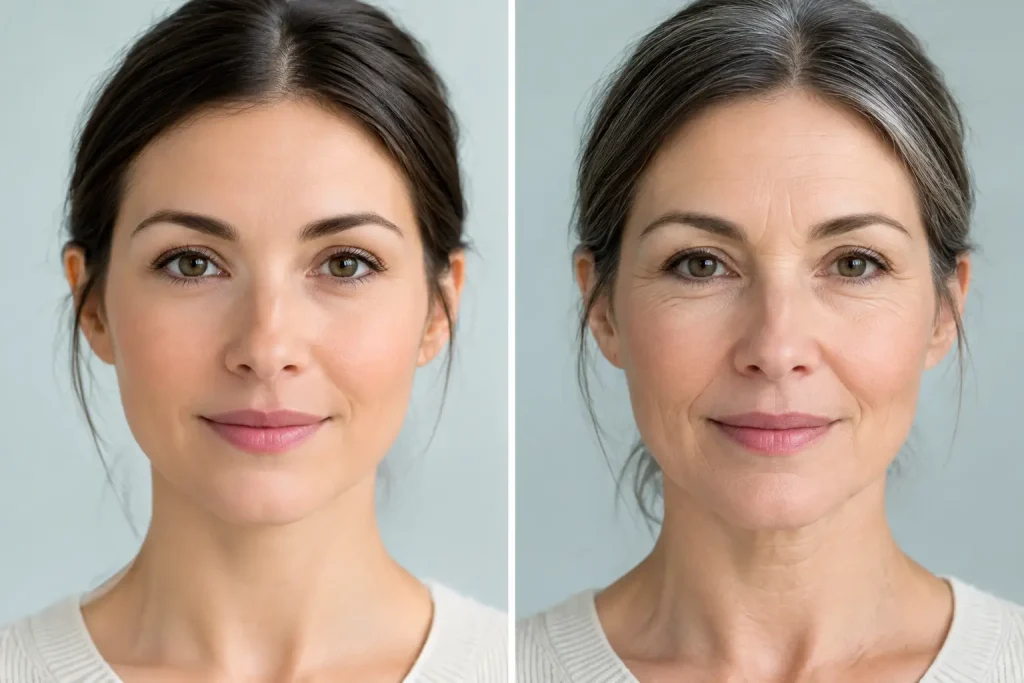
A longer-looking upper lip can change the entire expression of the face. It may soften the definition of the cupid’s bow, conceal more of the upper teeth at rest, and make the mouth appear less youthful even when the lips themselves retain volume. So, why does the upper lip become longer with age? The answer is not simply that the skin stretches. It is a layered process involving skin quality, collagen loss, facial support, dental changes, and the shifting proportions of the lower face.
For refined facial rejuvenation, the concern is rarely the upper lip alone. The most elegant treatment plan considers how the philtrum, vermilion border, teeth, nose, chin, and surrounding skin work together. A naturally beautiful result protects those relationships rather than chasing a single measurement.
Why Does the Upper Lip Become Longer With Age?
The visible upper lip consists of two distinct areas: the philtrum, or the skin between the nose and the red portion of the lip, and the vermilion, the colored lip tissue. With time, the philtrum generally lengthens while the vermilion may roll inward and appear thinner. This combination can create the impression of a longer, flatter upper lip.
In youth, the upper lip typically has clear structural definition. The cupid’s bow is more pronounced, the vermilion has a gentle outward turn, and a small amount of upper tooth show at rest often contributes to a fresh, relaxed appearance. As these features change, the lower third of the face can seem heavier or less animated.
Collagen and Elastin Decline
Collagen gives the skin its structural strength, while elastin allows it to return to its shape after movement. Both decline with age. Sun exposure, smoking, repeated pursing motions, genetic tendencies, and natural hormonal changes can accelerate this process.
As the skin of the philtrum loses firmness, it becomes more prone to vertical lengthening. Fine lines may also develop above the lip, particularly in people with expressive mouths or a history of smoking. These changes are not purely superficial. They often reflect a broader loss of support within the skin and soft tissue envelope.
The Upper Lip Loses Its Outward Support
A youthful lip is not defined by fullness alone. It is supported by the fat, muscle, and soft tissue architecture around it. With age, facial fat compartments can diminish or descend, and the upper lip may lose the subtle projection that once kept the vermilion visible.
The red lip can then turn inward, making it look narrower. This inward rotation may coexist with a longer philtrum, which is why adding volume alone does not always restore a balanced appearance. In some faces, excessive filler can increase projection without improving tooth show, lip shape, or the relationship between the nose and mouth.
Bone and Dental Changes Influence Facial Proportion
The facial skeleton also evolves over time. Resorption of bone around the maxilla, or upper jaw, can reduce support for the tissues around the nose and upper lip. The change is gradual, but its effect can be significant: the central face may appear flatter, and the lip may seem to descend.
Dental wear, tooth loss, bite changes, and reduced incisor support can further influence upper-lip position. This is one reason a sophisticated assessment may include dental history and smile dynamics. A patient whose upper teeth are no longer visible at rest may have a different concern from a patient whose teeth remain visible but whose lip has lost definition.
How a Longer Upper Lip Changes Expression
Facial aging is often recognized through proportion before it is recognized through wrinkles. A longer distance between the base of the nose and the vermilion can make the lips look less defined and may reduce the amount of upper-tooth display during speech and smiling.
This matters because tooth show is associated with vitality. In many younger faces, a small portion of the upper incisors is visible when the lips are relaxed. As the upper lip elongates and rotates inward, the teeth may become hidden. Some people notice that lipstick no longer sits as attractively on the lip border, while others feel their smile has become less open in photographs.
There is no single ideal philtrum length for every face. Sex, ethnicity, facial height, nasal shape, dental anatomy, and individual aesthetic character all matter. The goal is not to create a standardized short upper lip. The goal is to restore harmony while preserving a face that still looks distinctly like its owner.
Can Fillers Correct an Aging Upper Lip?
Hyaluronic acid fillers can be highly effective when the primary issue is early volume loss, reduced vermilion definition, or mild inward rotation of the lip. Carefully placed filler may support the white roll, refine the cupid’s bow, improve hydration, and create a more balanced transition between the skin and red lip.
However, filler does not physically shorten a significantly elongated philtrum. When it is used to compensate for true excess skin length, the result can become overly projected or unnaturally heavy. A refined approach treats filler as a tool for shaping and support, not as a universal substitute for surgery.
Neuromodulator treatment may also be considered in selected cases. Relaxing certain downward-pulling muscles around the mouth can subtly influence lip posture, although it cannot reverse structural lengthening. Energy-based skin treatments, regenerative therapies, and targeted skin care may improve texture and fine lines, but their ability to shorten the upper lip is limited.
When a Lip Lift May Be Considered
For patients with a clearly lengthened philtrum, minimal upper-tooth show, and an upper lip that has rolled inward, a surgical lip lift may offer a more structural solution. The procedure removes a measured amount of skin beneath the nose, elevating the upper lip and allowing more vermilion and upper teeth to show.
This is a small but technically demanding operation. Millimeters matter. An overly aggressive lift can distort the nostril base, create excessive tooth show, flatten the natural curvature of the lip, or leave an unfavorable scar. Conversely, an overly conservative adjustment may not achieve a meaningful improvement. Proper design requires careful evaluation of nasal anatomy, skin thickness, lip mobility, dental display, and the patient’s smile.
A lip lift may be performed as an isolated procedure or considered alongside other facial rejuvenation treatments. In some cases, restoring midface support, refining the nose, or addressing perioral lines changes what is appropriate for the lip. The best plan depends on which aging mechanism is dominant.
A Personalized Assessment Makes the Difference
The most successful upper-lip rejuvenation begins with observation rather than treatment selection. A facial aesthetic surgeon should assess the lip at rest, during speech, in a full smile, and in profile. The relationship of the upper lip to the nose, teeth, lower lip, and chin should be examined as one composition.
At a premium facial aesthetics practice such as Dr. Güncel Öztürk’s, this analysis is approached with both surgical precision and an artistic understanding of proportion. The question is not merely whether the upper lip has become longer. It is whether that change is disrupting the facial balance that makes a person look expressive, rested, and naturally refined.
A longer upper lip is a normal part of facial aging, but it does not have to be addressed with a one-size-fits-all solution. When treatment respects anatomy, movement, and individual character, even subtle adjustments can restore a more luminous relationship between the smile and the face around it.